

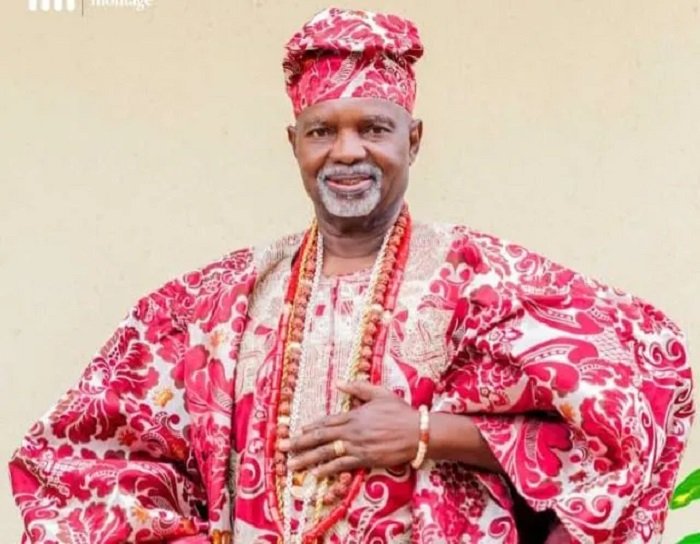
Ibadan woke up on Saturday, August 1, 2026, to the painful news of the death of one of its most recognisable sons, Oloye AbdulRasheed Olalekan Alabi. He was 75.
Oloye Alabi, a veteran journalist, public relations expert, author, cultural ambassador and respected traditional chief, reportedly died at about 9 am at a hospital in Lagos after a brief illness.
His death has left a huge vacuum across Ibadan’s social, corporate, traditional and media circles.
For decades, Oloye Alabi was more than a familiar face at important events. He was a repository of history, an astute communicator and one of those rare personalities who could move effortlessly between the newsroom, the boardroom, the palace and high society.
He was stylish. He was witty. He was polished. He was eloquent. Above all, he carried himself with an unmistakable confidence that reflected his deep knowledge of Ibadan history, Yoruba culture and public affairs.
His Last Moments
His daughter, Mrs. Modupe Odusola, gave City People an emotional account of her father’s final moments.
According to her, she was with him at the hospital in Lagos when the sad incident occurred.
“I was in the hospital. Daddy was in the hospital. He had a brief illness. He was sleeping and then the doctor came and said, ‘Baba ti lo,’” she recalled.
The news shattered her.
“Of course, I reacted badly. I was so pained despite the fact that he wasn’t a young man,” she said.
For Modupe, the pain was particularly deep because of the special relationship she shared with her father.
“My sister and I are very close to my dad. We argued that we don’t know which of us is his favourite,” she said with emotion.
Oloye Alabi had spent the last few months in Lagos with her, further strengthening their bond.
“He was with me. He spent the last few months in Lagos with me. So we were very close,” she added.
‘Daddy Was Very Full of Life’
Describing the man behind the public persona, Modupe painted a picture of a father who was deeply passionate about life and people.
“Very full of life. He loved and enjoyed life. He loved people. He loved history. He loved tradition,” she said.
His passion for tradition was not merely academic.
According to his daughter, Oloye Alabi was increasingly worried about the erosion of traditional values and the consequences for society.
“He was sad that we were losing tradition and that tradition is the bedrock of our value system,” she said.
Then came the words that perhaps best captured his personality.
“He was very peaceful. He was cerebral and cosmopolitan. He was very brilliant.”
For Modupe, her father’s extraordinary memory was another remarkable quality.
She recalled how he could confidently recount dates, times and details of events that happened many years earlier.
“I used to say to Daddy, ‘Are you sure all these things you are saying are accurate?’ And he would say, ‘Go and check it.’”
Whenever she checked, she said, his recollection was usually correct.
“He would quote time, date and details of events of many years back and when I checked, I found that they were actually accurate.” Then she summed him up simply: “He was the best of everything.”
A Father Who Taught By Example
Beyond his public achievements, Oloye Alabi was first a family man. His daughter said the lessons she learnt from him while growing up have remained important throughout her life.
“Family. Family is important. Enjoy oneself. Hard work. Believe in God,” she said. Her father also taught his children not to allow their background to limit their dreams.
“Your background doesn’t dictate what you can become. You can be anything you want to be.”
She described him as peaceful and kind, a man who wanted people around him to be happy and to do what was right.
“He embraced a lot of people. He embraced his family and his extended family,” she said. Even while mourning her father, Modupe said she was already thinking about the many people who would feel his absence.
“As much as I’m mourning right now, I am mourning for them too because they are going to really miss him.”
Asked what she would miss most about him, the answer came quietly. “His calmness.”She became emotional. “My dad was always there.”
Born on October 27, 1950, in Ibadan, Oloye Alabi was steeped in the history and traditions of the ancient city from childhood.
He was born into the Oyetunji Olundegun and Ekerin Ajengbe families of Ibadan. His early upbringing reflected the traditional Ibadan compound system, where elders played collective roles in raising children.
His educational journey took him through the Seventh-Day Adventist Primary School, Oke-Foko, and African Church Grammar School, Apata Ganga, Ibadan.
He began working as a teacher before joining Onibonoje Press Limited, Ibadan, as its pioneer editorial assistant. That was the beginning of a remarkable media career.
From Sketch to The World of Public Affairs
In 1973, he joined Sketch Publishing Company Limited as a reporter, writer and reader. He quickly distinguished himself.
He became the newspaper’s youngest and first dual columnist, writing for both the English-language Sunday Sketch and its Yoruba-language publication, Gboungboun.
His journalism took him to the famous College of Journalism, Fleet Street, London, in 1976. Upon his return, he moved into television journalism, working with the former Nigerian Television Authority, Ibadan, before becoming one of the pioneering editorial staff of the Television Service of Oyo State, now BCOS-TV, when it commenced transmission in 1982.
His career soon moved into government. In 1983, he was seconded to serve as Press Secretary to the then Governor of old Oyo State, Chief Bola Ige.
He subsequently served three military governors — Major-General Oladayo Popoola, Brigadier-General Adetunji Olurin and Brigadier-General Sasaenia Oresanya. In all, he served four governors between 1983 and 1989.
His public relations career continued at Odu’a Investment Company Limited, where he became the pioneer Public Affairs Manager and eventually General Manager, Corporate Affairs. He voluntarily retired in 2006 after 17 years with the conglomerate.
Retirement never meant withdrawal from public life for Oloye Alabi. He remained a journalist, columnist, author, public affairs analyst, motivational speaker and cultural advocate.
His knowledge of Ibadan history and Yoruba tradition eventually found expression in his traditional chieftaincy career. He was installed Mogaji of the Oyetunji Olundegun family in 1994.
He later rose through the ranks of the celebrated Ibadan traditional chieftaincy system, serving in various capacities before becoming one of the senior chiefs of Ibadanland.
In 2016, he was elevated from Aare Alaasa Olubadan to Agba-Akin Olubadan. His elevation was significant because the title had a historical connection with his ancestral lineage. In 2022, he was further elevated to Maye Olubadan of Ibadanland.
He also served as Cultural Ambassador of the National Museum and Monuments, Ile-Ife, a role that reflected his lifelong passion for Yoruba history and heritage.
Perhaps the greatest measure of Oloye Alabi’s life is the number of people who considered him their own. To some, he was a mentor. To others, he was a father figure.
For many, he was simply a good friend. His passing therefore goes beyond the loss of an accomplished journalist or traditional chief. Ibadan has lost one of its living historians.
The media has lost an experienced practitioner who understood the power of words. Corporate Nigeria has lost a polished public relations professional.
The Ibadan traditional circle has lost a knowledgeable custodian of its history. The social scene has lost one of its most distinguished personalities. And several generations have lost a man who was always willing to share his knowledge.
The Sober Mood at Akobo
By Saturday evening, the reality of his death had settled heavily over his Akobo residence in Ibadan.
When City People Correspondent visited the residence, his widow, Chief Mrs Tokunbo Alabi, was surrounded by sympathisers who had arrived to condole with the family. The mood was sober.
A condolence register had already been opened as friends, associates, traditional chiefs, journalists and well-wishers continued to arrive.
Although Oloye Alabi did not die young, the atmosphere remained heavy. His age offered little comfort to those who knew him. For a man who spent his life connecting people, his absence was already being felt.
His 98-year-old Mother
Perhaps one of the most heartbreaking dimensions of the tragedy is the condition of his aged mother. City People gathered that Oloye Alabi’s mother, who is 98 years old, has reportedly refused to eat for about a week. She has also continued asking for her son. That detail makes the loss even more painful for the family.
A mother who has lived for nearly a century has now been confronted with the painful reality of losing her son.
‘Eyin Merin Yi Nikan Ni Mo Ni’
Modupe, who is 46 and a lawyer, is Oloye Alabi’s second child and first daughter. She is married with children. Her elder brother is also a lawyer and lives in the United Kingdom. Her younger sister is a lawyer based in Lagos.
The last child, Tunji, was particularly close to his father and became the coordinator of many of Oloye Alabi’s affairs as he grew older.
Modupe recalled a statement her father repeatedly made to her as he aged.
“He kept telling me when he was getting older, ‘Don’t let anybody come and tell you that I have other children anywhere o. Eyin merin yi nikan ni mo ni.’” The four children, she said, were his world.
Will Be Buried Sunday
As a Muslim, Oloye Alabi will be buried according to Islamic rites. According to Modupe, the burial is scheduled for Sunday at Eternal Home Private Cemetery.
After the immediate burial, the family will come together to plan a more elaborate befitting ceremony in his honour.
“We are most likely to do the 40 days, by God’s grace,” she said. But there is a personal promise behind the preparations.
“I will do it in a way that Oloye will not come and appear to me and say, ‘Jo, se bo se ye ko sinmi niyen.’”
Then came the emotional pledge from a daughter who has just lost her father.
“I will bury my daddy well.”
And perhaps, in those words, lies the essence of the grief now hanging over the Alabi family.
Oloye Lekan Alabi lived for 75 years. He built a career. He built relationships. He preserved stories. He championed tradition.
He mentored people. He raised a family. And he left behind a name that will remain woven into the history of modern Ibadan.
For a city that prides itself on its history, losing a man who knew so much of that history is no ordinary loss.
Ibadan will miss Oloye Lekan Alabi.
-Dare Adeniran
08057639079
