


Dementia and Alzheimer’s disease are increasing rapidly across Africa, yet they remain dangerously misunderstood. This op-ed examines how witchcraft beliefs—reinforced by films, media, and opportunistic faith leaders—fuel stigma, abuse, and human rights violations against the elderly. It argues that Nigeria, through Nollywood, religious institutions, and public health systems, has both a responsibility and an opportunity to reshape public understanding and protect its ageing population.
When Old Age Becomes a Crime
In many parts of sub-Saharan Africa, growing old can be dangerous—not because of age itself, but because of what society believes about it. Dementia, Alzheimer’s disease, and other mental health conditions are still widely misunderstood and, in some communities, interpreted as witchcraft. The consequences of this misconception are devastating: stigma, abandonment, social exclusion, and, in extreme cases, physical violence.
An elderly person should not have to fear accusations simply for losing memory or behaving differently. Yet across communities, especially where access to mental health education is limited, old age is increasingly criminalised rather than protected.
A Medical Condition, Not a Supernatural Curse
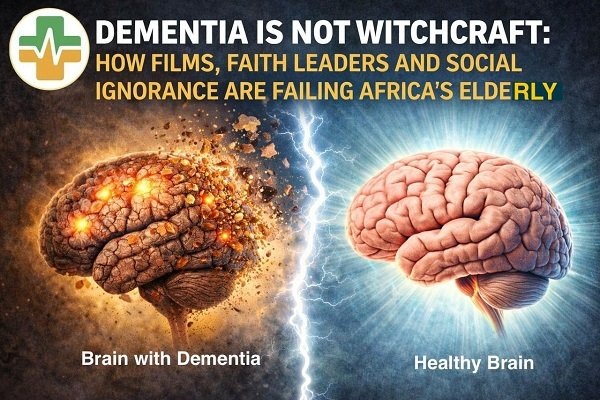
Dementia is a medical condition. It is a progressive decline in memory, reasoning, language, and behaviour caused by diseases affecting the brain. Yet across several African countries, these symptoms are often framed through supernatural explanations. An elderly woman who forgets familiar faces is labelled cursed. An older man who speaks incoherently is accused of dark powers. Instead of care, they are met with fear.
This misunderstanding not only isolates the individual; it exposes them to abuse, neglect, and social rejection—often from the very families meant to protect them.
How Movies Shape What We Believe
These beliefs do not exist in isolation. They are reinforced by cultural narratives, religious misinterpretations, and increasingly, popular media. Film industries across the continent—and most notably Nigeria’s Nollywood—have played a powerful role in shaping public perception. Characters displaying symptoms of mental illness or cognitive decline have often been portrayed as witches, possessed, or agents of evil.
Movies may be fiction, but they educate. When millions consume these stories without access to mental health education, fiction quietly becomes belief. The result is a society primed to fear illness rather than understand it.
Faith, Fear, and Exploitation
Even more troubling is the exploitation of this fear. Some opportunistic clergy have capitalised on deeply rooted beliefs in witchcraft, presenting themselves as spiritual saviours while subjecting vulnerable elderly people to humiliation and abuse. There are cases of older adults being forced to “confess” to witchcraft based on nonsensical speech or erratic behaviour—classic signs of dementia.
What should trigger a medical evaluation instead becomes a public performance of shame, all in the name of deliverance.
A Public Health and Human Rights Crisis
This is not merely a cultural problem; it is a public health and human rights crisis. Africa’s population is ageing, and as life expectancy rises, so will the prevalence of dementia. The World Health Organisation has warned that low- and middle-income countries will bear a disproportionate share of the global dementia burden, largely due to weak health systems and poor awareness.
Ignorance does not reduce disease—it only deepens suffering.
Nigeria’s Responsibility and Opportunity
Nigeria sits at a critical crossroads. As Africa’s most populous nation and home to one of the world’s largest film industries, it has immense power to either reinforce harmful myths or dismantle them. Nollywood, content creators, and broadcasters can choose to tell better stories—stories that humanise ageing, explain disease, and challenge superstition.
Faith leaders, too, have a responsibility. Religion is deeply embedded in Nigerian society and can be a force for compassion rather than condemnation. When pastors, imams, and traditional leaders understand dementia, they can guide families toward care instead of blame.
What Must Change
Reframing dementia as a disease—not a curse—requires coordinated action. Governments must invest in mental health services and caregiver support. Public health institutions must prioritise community education in local languages. Media regulators and creators should promote responsible portrayals of mental illness.
“As a society, we must ask ourselves: what does it say about us when we treat our elders as threats instead of patients?”
A Final Word
Dementia is not witchcraft. It is not punishment. It is not possession. It is a medical condition that demands empathy, knowledge, and care. Until this truth is fully accepted, ignorance will continue to masquerade as culture—and the elderly will continue to pay the price.
“Dementia is a medical condition—not a curse, not a punishment, not witchcraft.”
Our elders deserve care, not fear:
About the Author
Otunba (Dr.) Taiwo Olubanwo is a Canada-based public health expert, medical professional, executive director of primary health care, chief consultant in mental health and addictions, and distinguished scholar. He has delivered transformative leadership across Canada and selected African countries, strengthening health systems and advancing health equity and social justice. Dr. Olubanwo has led high-impact research, policy, and community initiatives that improve access, quality, and equity in care. A thought leader in culturally informed public health, he is widely recognised for bridging research, policy, and frontline practice to protect vulnerable populations and advance global health and system-level innovation.
