

-
What No One Will Tell You
In Vitro Fertilization (IVF) is a revolutionary approach to assisted reproduction, offering hope to millions of couples struggling with infertility. Though IVF is considered to be a very safe procedure, like any medical intervention, IVF comes with some risks and side effects that are worthy of exploration.
IVF RISKS AND SIDE EFFECTS
In vitro fertilization (IVF) treatment entails retrieving eggs from a woman’s ovaries and fertilizing them with sperm in a laboratory to create embryos. These embryos are then transferred to the woman’s uterus, where some embryos will implant into the uterine lining and develop into live births.
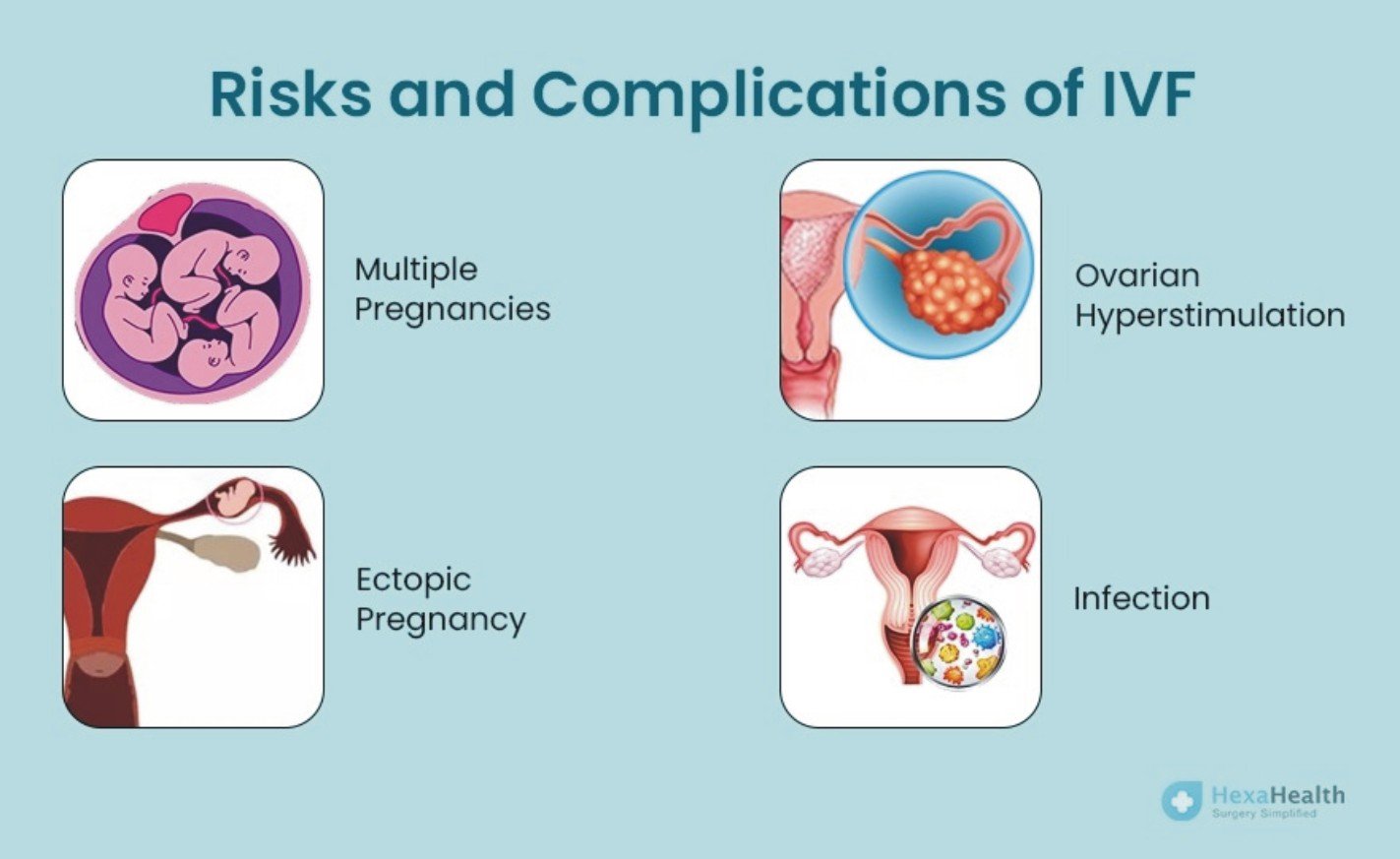
As a complex medical procedure with multiple steps, there are factors and situations in IVF that have the potential for some risk, including:
Ovarian hyperstimulation syndrome from stimulation medications.
Complications during egg retrieval.
Complications during embryo transfer.
Increased risk of twins or multiples.
Potential birth defects.
Potential for ectopic pregnancy.
Potential for pregnancy loss or pre-term birth.
Of course, several of these, like birth defects, ectopic pregnancy, pregnancy loss and pre-term birth, are risks of every pregnancy.
RISKS ASSOCIATED WITH IVF MEDICATIONS
The most common IVF medications are administered via subcutaneous injection. These include:
Gonadotropins that stimulate the ovaries to produce multiple eggs.
Estrogen and progesterone are used to prepare the uterine lining for implantation of an embryo.
The amount and type of medication will be tailored to your individual IVF plan. There are many medications used in fertility treatments, but these are some of the standard ones.
Studies show that these medications are considered safe when used for in vitro fertilization (IVF), with most women experiencing no greater risk or side effects to their overall health and pregnancy than women who conceive unassisted.
That said, there are some potentially serious risks and negative side effects that occur on occasion.
OVARIAN HYPERSTIMULATION
Ovarian Hyperstimulation Syndrome is the most serious risk of IVF. OHSS occurs when follicles are overstimulated and become swollen. This causes the ovaries to become much larger than normal because we are stimulating that month’s entire group of eggs to grow, rather than just one. In a non-stimulated menstrual cycle, estrogen levels only increase to around 100-200 picograms at its peak. During IVF, that level can reach to the hundreds to thousands. Most cases of OHSS have mild and moderate symptoms, such as mild pain in the ovaries, bloating, and nausea. Though very rare, OHSS can also have severe symptoms associated with fluid buildup in the abdomen and chest, blood clots, and kidney failure. Severe OHSS decreases blood volume and can set the stage for stroke-like symptoms, including calf pain, deep vein thrombosis, shortness of breath, chest tightness, blood clots in the lungs, and pulmonary embolism. Moderate to severe OHSS affects around 1% of women undergoing IVF.
WHAT CAUSES OVARIAN HYPERSTIMULATION:
Ovarian hyperstimulation occurs most often after the use of injectable gonadotropins like follicle-stimulating hormone (FSH), which is used to stimulate the eggs in the ovaries to grow. This is followed by human chorionic gonadotropin (hCG). hCG is used to trigger the final maturation of eggs in a woman’s ovaries. Fortunately, OHSS can be effectively managed and prevented by adjusting your medication protocol.
HOW TO REDUCE THE RISK OF OVARIAN HYPERSTIMULATION:
To minimize the risk of OHSS, specialists will consider your age and ovarian reserve number (anti-müllerian hormone), among other factors, to determine a protocol that’s best tailored for you. During IVF stimulation, they will closely monitor ovarian response to medications through regular ultrasound scans and assessments of hormone levels. The most common and effective strategy for reducing the risk of OHSS is to choose the correct medication protocol and adjust medication dosing as needed throughout stimulation.
OVARIAN CANCER
Some older studies have suggested a potential association between using fertility medications for long periods of time and a small increase in the risk of ovarian cancer for women who do not ultimately conceive after treatment. However, this link is not “causal,” and it may be that the underlying reasons that these women do not conceive are responsible.
However, numerous recent studies have NOT found an increased risk of ovarian cancer.
Risks of IVF egg retrieval
During the egg retrieval procedure, a thin needle is guided by ultrasound imaging as it is inserted through the vaginal wall and into the ovaries. The needle then draws follicular fluid containing the eggs from each follicle.
Some potential risks of egg retrieval include:
After the retrieval, it is common to experience mild to moderate abdominal and/or pelvic pain, constipation, and bloating. For most women, the pain goes away on its own within a few days. If needed, you can manage pain and/or constipation with over-the-counter medications.
Injury to organs near the ovaries, such as the bladder, bowel, or blood vessels is also a risk of egg retrieval. These uncommon puncture injuries are usually superficial, but on very rare occasions, such as when a blood vessel is struck, there may be the need for emergency surgery.
As with any surgical procedure, there is always a risk of infection and risks that come with anesthesia. Our anesthesia providers will review risks of anesthesia with patients individually before the procedure. Puncture wounds from the aspirating needle can also become infected. However, most clinics administer antibiotic medications through the IV at the time of egg retrieval, making infections very uncommon. The risk of infection is less than 1 in 100 people.
The risk of infection increases for women who have previously had pelvic infections or ovarian endometriosis.
RISKS ASSOCIATED WITH IVF EMBRYO TRANSFER
For the transfer procedure, abdominal (and rarely transvaginal) ultrasound is used to guide a thin, flexible catheter containing the embryo through the cervix and into the uterus, where it is deposited. This is a safe procedure with a few potentially mild side effects.
The most significant risk associated with embryo transfer is the chance of multiple pregnancies (twins) when multiple embryos are transferred at the same time. Since embryos can split, this can also happen with the transfer of one embryo. Twins are considered a high-risk pregnancy.
RISK OF TWINS AND MULTIPLE PREGNANCY WITH IVF
The more embryos that are transferred into the uterus, the greater the risk is of having a multiple pregnancy. This risk can vary based on the age of the person when the eggs were retrieved. The younger the eggs are, the higher the risk.
In the early days of IVF, it was believed that transferring more embryos equated to a better chance of implantation and pregnancy. Embryo freezing was also not as developed, resulting in a high rate of embryos not surviving the freeze and thaw process.
However, the modern standard at most fertility clinics, including CNY, is elective single embryo transfer (eSET). With the ability to genetically test embryos, this standard procedure of transferring one embryo at a time becomes even more strongly recommended. Transferring a single embryo provides essentially the same success rates as a multiple embryo transfer and is safer for patient and baby.
Single embryo transfers allow leftover embryos to be frozen and used for future Frozen Embryo Transfers if the first attempt fails, or if you want to have more children in the future.
If, for some reason, it is in your best interest to transfer multiple embryos, your provider should transfer the minimum number necessary to provide the highest likelihood of pregnancy safely.
The risks of multiple pregnancies include:
Miscarriage.
Premature birth.
NICU stay.
Bleeding.
Prolonged bed rest.
Preeclampsia.
Gestational diabetes.
Pregnancy-induced hypertension.
Increased need for cesarean section.
Postpartum depression.
Developmental disabilities.
Cerebral palsy.
Increased infant mortality rates.
Risks of birth defects with IVF.
In vitro fertilization involves a series of complex medical procedures, each with its own specific risks. However, the overall process is remarkably safe and well worth the minimal risks involved for most people.
cnyfertility.com
