

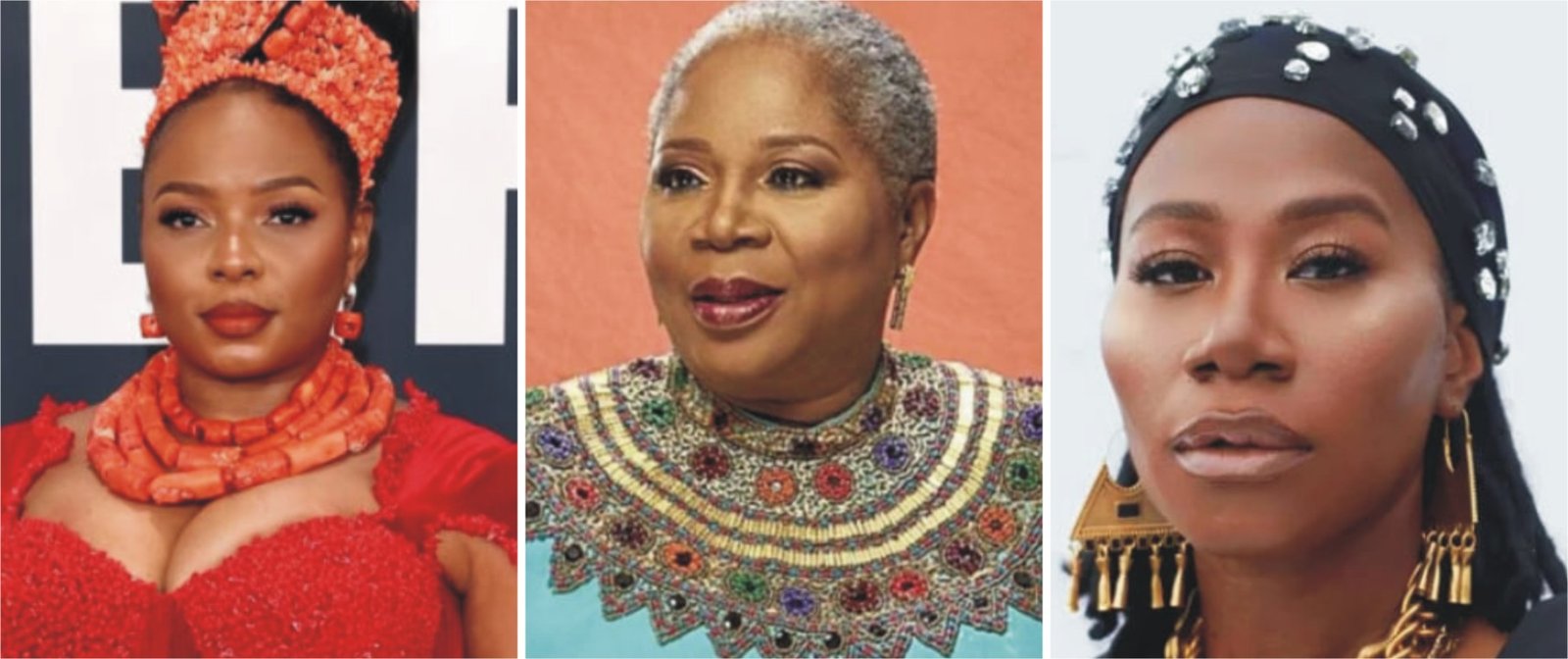
From trailblazing pioneers and gospel icons to Afrobeats queens and global superstars, these are the women whose voices, talent, influence and timeless music have shaped the Nigerian music arena for generations. Who is the greatest Nigerian female musician of all time?
It is one of those questions that has no single correct answer. Ask 100 Nigerians and you are likely to get 100 different opinion. Some will choose the pioneers who laid the foundation. Others will argue for the women who conquered Africa, while a younger generation may insist that today’s global superstars deserve the crown.
This ranking celebrates every era of Nigerian music—from the highlife and disco revolution of the 1970s and 1980s to the rise of contemporary Pop, R&B, Reggae, Gospel, Afro-house, Soul and today’s globally celebrated Afrobeats movement.
City People Showbiz Reporter, DANIJI EMMANUEL chronicles the 20 greatest Nigerian female musicians of all time.
TY BELLO
Before she went solo, TY Bello was the female voice of KUSH, the turn-of-the-millennium supergroup that briefly made gospel-pop feel like the coolest thing in the country. Her 2008 debut ‘Greenland’ — anchored by the airy title track and the tender ‘Ekundayo’ — proved she could carry a record on her own terms.
But to box TY Bello into music alone is to miss half of her genius. She is one of Nigeria’s most sought-after photographers, the eye behind portraits of presidents and icons. In recent years, she has retreated into worship, curating spirit-heavy sessions that feel less like performances and more like offerings. She remains a rare talent who colours outside every line.
CHIOMA JESUS
There is gospel music, there is worship, and then there is the rousing, sweat-drenched praise that Chioma Jesus conducts like a general marshalling troops. Born Chioma Ozurumba, she is a fixture in Igbo Christian homes and across Nigeria, the voice that can turn a quiet living room into a full-blown revival.
Her medleys are marathons of momentum with call-and-response chants stacked on relentless percussion until surrender feels inevitable. Her name on programme flyers can pull a crowd on its own, and only a few musicians can match her ability to lift a crowd (or congregation) from its seats to its feet.
KEFEE
The Delta-born singer arrived in the mid-2000s with ‘Branama’, a jubilant burst of gospel-pop so infectious it birthed its own catchphrase and dance. For a moment, the whole country was speaking Kefee’s language.
Her music refused to sit still. It bounced, it praised, it celebrated, reminding Nigerians and everyone who heard her songs that worship could also be a party. Her death in 2014 robbed Nigeria of one of its most exuberant voices far too soon, but ‘Branama’ still detonates joy on any dancefloor lucky enough to host it. Some flames burn briefly and never go out.
NINIOLA
Long before amapiano colonised Nigerian playlists, Niniola was already dancing in that pocket. The elder of the Apata sisters turned a third-place finish on Project Fame into a lane of her own. With her sultry, hip-swivelling fusion of Afrobeats and house that earned her the unofficial crown “Queen of Afro-House”.
‘Maradona’ and ‘Sicker’ are masterclasses in tension and release, built for sweaty basements and open-air raves alike. Her stock as a writer is just as high; a credit on Beyoncé’s ‘The Lion King: The Gift’ placed her in rarefied company. Niniola bet on a sound the mainstream hadn’t caught up to yet, and she won.
TENI
If Niniola brought the groove that Nigerians did not know that they needed, her younger sister Teni brought the grin and even more versatility. “Teni the Entertainer” is exactly that — a big-voiced, big-hearted everywoman who writes hits that sound like they were made on your streets.
‘Case’, ‘Askamaya’ and the tear-jerking ‘Uyo Meyo’ showcase a rare gift: the ability to be funny and profound in the same breath. Her writing skills are out of this world, co-writing one of the greatest songs in Afrobeats history; Davido’s ‘Fia’, proof that her talent stretches well beyond her own catalogue. Teni disarms you with humour, then floors you with heart. That is a magic few possess.
WAJE
There are few artistes in history with the vocal consistency that Waje possesses. Her anonymous presence on the 2008 smash hit ‘Do Me’ by Psquare led to amateur sleuths uncovering the woman behind the hook. Waje has a knack for showing up in “the best of” discographies, especially that of the class of 2008.
Her duet with M.I, ‘One Naira,’ is hands down one of the best love song collaborations in Afrobeats history. She is critical to the blossoming of the R&B genre in the late noughties. While she made collaborations blossom, Waje can stand on her own. Her 2013 hit single ‘I Wish’ is a soulful Reggae song that carries the pain of heartbreak. Waje’s self-titled first album remains one of the best contemporary LPs.

STELLA MONYE
History has been unfair to Stella Monye, a delicate pop singer who left her mark in the 1980s. She was one of the significant female acts during this period of pop relevance.
Stella Monye’s music is steady and reliable. Its simplicity does not dilute its resonance. While knockout female artists of this time, like Onyeka, Evi Edna and Christie Essien Igbokwe, gave you knockouts, Stella Monye was the pugilist who won the round by delivering consistent punches.
OMAWUMI
Omawumi comes with gravitas and strength like the Amazons before her. With talent and a premium range, she has heavy grassroots appeal. Her songs possess common man and woman sensibilities. Omawumi’s music touches on themes such as the celebration of identity and heritage and perseverance.
If there is any singer who successfully took on the torch from the likes of Onyeka Onwenu and Christy Essien Igbokwe, it would be Omawumi. She embodies the “diva” concept in every classical sense of the word. Sometimes it feels like she was born in the wrong era. While many TV show contestants disappear into oblivion, Omawumi bucked the trend with brawn.
SIMI
Simi, a woman-next-door singer with middle-class sensibilities, has crafted a career out of composing love anthems for your everyday girl. The aesthetics of her music shuns the exotic, for realness, warmth and love fairytales.
In 2019, she won the “Album of the Year” category at the Headies for her debut album, a rare feat for a female act. Her transition into motherhood saw her score the African hit ‘Duduke’. Simi has a piercing voice that complements her smooth writing style.
TEMS
Tems often boasts that no one has done what she has done. And it is hard to argue with that. She has become a consistent feature on the Billboard charts, topping the Top Hot 100 for her contribution to Future’s ‘Wait For U’, also featuring Drake, and she won a historic GRAMMY Award for this before winning another one for her refix of Seyi Sodimu’s Love Me Jeje in 2025.
Her collaboration with Wizkid, ‘Essence’, broke barriers for Afrobeats in the North American soundscape. Tems’ penmanship is highly sought after. Rihanna enlisted her to co-pen her return single, ‘Lift Me Up’, which earned her an Oscar nomination. Most importantly, her soulful style cuts across races. Her songs flaunt an emotional depth not bound by borders. Tems is an outlier who has broken the rules.
TIWA SAVAGE
We can count the number of hits Tiwa Savage has racked under her designer belt, both as a solo act or featured act, and it would still not sufficiently explain why she is on this list. Yes, her pen game hangs with the best and no matter what, Tiwa Savage delivers strong albums and at least a hit every year.
Culturally, Mummy Jam Jam has been the torchbearer for a generation of women who want to live life according to their rules. Her debut single ‘Kele Kele Love’ saw her inject American beauty aesthetics into the Nigerian scene. Her follow-up ‘Love Me 3X’ set the ball rolling for Tiwa Savage, acting as a barrier breaker for women to express their sexuality in the music space and the criticisms that followed.
The boob drama of ‘Love Me 3X’ would snowball into more ridiculous censorship. She got dragged for ‘Wanted’ and criticized for wearing a bikini a few days after her wedding.
Then there was the marriage scandal and the rumoured high-profile relationship with Wizkid. Yet, no Nigerian female artist has generated more think pieces than Tiwa Savage. Yet, she still keeps banging out hits for a decade plus. Today, the new young crop of female acts feels bold to make their own choices because of the bullets Tiwa Savage took.
YEMI ALADE
Those in the know will not dispute the fact that Yemi Alade is Nigeria’s most prominent female export, especially in African countries. The new “Mama Africa” shuts down stadia like Psquare and other African greats. To see Yemi Alade live is an experience. She is an electric force that threatens to explode into a million fireworks while she is on stage.
Her 2013 runaway smash hit ‘Johnny’ is as relevant as any crossover Afrobeats record like ‘Ye’, ‘If’, or ‘Ojuelegba’. In 2017, she sold out the Le Trianon venue in Paris, France. This was before the term “sold out venue” was part of Afrobeats lexicon. Yemi Alade is an intercontinental rockstar who has uniquely positioned herself in this period of the Afrobeats gold rush.
LIJADU SISTERS
The music of the Lijadu Sisters can be baffling to tag. It is oddly cohesive, like the music of their cousin Fela Anikulapo-Kuti, and sometimes funky and trippy like William Onyeabor’s. Taiwo and Kehinde Lijadu emerged at the cusp of the experimental 70s that witnessed the rise of Afrobeat and psychedelic rock. They were relevant for two decades and consistently continued to push the envelope.
Their music was edgy with social and political commentary. Their influence in Nigerian music was highlighted when pop star Ayra Starr sampled their classic song ‘Orere Elejigbo’ on ‘Sare’. It is impressive to see alternative icons inspiring an alt-pop star 42 years later.
QUEEN SALAWA ABENI
Not many 15-year-olds sell a million copies, and Queen Salawa Abeni did that on her debut album, Late General Murtala Ramat Mohammed, named after the late Head of State, Murtala Muhammed. She was a prodigy who blossomed to be perhaps the most recognised voice of the “waka” genre for two decades.
The rollicking 70s would give way to the heady 80s as Queen Salawa Abeni became fodder for rag-tag gossip magazines over her beef/affair with Fuji icon Ayinla Kollington and split from her first husband/label boss Lateef Adepoju of Leader Records. The rocky times did not affect Salawa Abeni’s output. She released 17 documented albums in the decade.
In 1992, the Alaafin of Oyo crowned her the “Queen of Waka Music,” before she released her most enduring hit, ‘Gentle Lady,’ to resounding success. Throughout her mission of popularising Waka, Queen Salawa Abeni refused to be swallowed by the tabloids. She displayed great agency during such patriarchal times.
TOPE ALABI
Nobody intersects Nollywood and Nigerian music as expertly as Tope Alabi. Her voice was borderline omnipresent in the Yoruba film industry videos where she sang over 350 soundtracks, doubling as a singer and faux-narrator of events that would play out several scenes later.
Her soundtracks touched on spirituality and life lessons, two themes she has stuck to as she pivoted into a full-time gospel minister. With 14 albums to her credit, Tope Alabi is unrivalled in her eloquence in using Yoruba as a spiritual medium to contact the Heavens.
SINACH
The powerhouse of Gospel music in Nigeria, Sinach, is unarguably the most famous female singer in Christian households. Incubated in Christ Embassy (the best talent development shelter for Gospel acts, but that’s a story for another day), Sinach has emphasised the depth and strength of her genre in Nigeria.
While the Gospel industry is littered with many star worshippers, Sinach is the exemplar. In December 2015, she released the single ‘Way Maker.’ The resounding success and impact of the song are as important as any of the crossover Nigerian pop records in the last decade. Her success challenges the monolithic concept of Afrobeats’ dominance and its export value.
CHRISTY ESSIEN IGBOKWE
Contrary to popular belief, this is not the first time in Nigerian music history that artists and albums are packaged for foreign consumption. In the early 80s, foreign labels scooped promising Nigerian talent and tried to break them internationally. A recipient of that was Christy Essien Igbokwe. In 1981, she released her most successful album ‘Ever Liked My Person’ off the strength of her hit single ‘Seun Rere’.
Christy Essien Igbokwe is, however, more than a footnote in the London fever era. Christened Nigeria’s Lady of Songs, Igbokwe possessed a powerful voice that sometimes held on to the pain and anguish of a generation. Her range was impressive, too. She sang disco, folk and boogie.
Beyond singing, Igbokwe was just as important. She was a founding member of the Performing Musicians Association of Nigeria in 1981. By 1996, she was PMAN’s first female president, a position she held for three years.
At 16, she joined the cast of arguably Nigeria’s greatest sitcom, ‘The New Masquerade’. Later on, she would star in several Nollywood films.
EVI EDNA OGHOLI
Before Ken Saro-Wiwa marched for the rights of the Ogoni people and Timaya sang about the Odi massacre, Evi Edna Ogholi came from the boondocks of the oil-rich Niger Delta region and captured Nigeria with effective simplicity.
Her voice in the 1980s and 1990s was one of the most distinguishable. Her Reggae records with a pop slant (like ‘Happy Birthday’) were among the ubiquitous songs. Every time a Dallas cake got wheeled out to the dancefloor, the DJ played this song.
Straightforward tracks like ‘Jealousy’, and ‘Message to the Youth’ only define the top layer of who we know as Evi Edna Ogholi. At 20, she left Delta for Lagos with nothing but a dream and a demo. Two years after (1987), she came out with her debut album ‘My Kind of Music’ under Polygram, now Premier Music.
Her output was prolific. Her second and third albums were released in 1988 and spawned the hits ‘Obaro’, ‘Ririovara (Dry Your Tears)’ and more. In the following year came her fourth album. Her fifth and sixth studio efforts came out in 1990. Ogholi bodied during this period, with three of her albums achieving platinum status.
The Reggae act is more than numbers. She has an indelible imprint on Nigerian music. Evi Edna Ogholi waved the green, gold, and red flag with the Lion of Judah as Rastafarian ideology and Reggae music swept through the country in the 80s. She belonged to the class of The Mandators, Majek Fashek, Oritz Wiliki and Ras Kimono, who used the Zion/Babylon struggle to sing about the country’s woes.
Her style of Reggae music was unique. She sang many of her records in the Isoko dialect and found relevant space in the WA-ZO-BIA monopolistic triangle. She even delved into other genres like Folk and Country music.
By 25, Evi Edna Ogholi sealed her legacy as one of the greats. She deserves a unique spot for being a leading Reggae exponent without having her light diminished by her male counterparts.
ASA
While some classic debut albums are dragged laboriously from generation to generation, some float effortlessly into immortality. Asa’s self-titled debut belongs to the latter. Released in 2007, during the 2face Idibia, PSquare and Mo’ Hits triumvirate, Asa’s album pierced through the prevalent sound of the day.
Asa came out as the girl next door with alternative sensibilities. She sounded like she spent hours listening to Tracy Chapman and Janis Joplin. She looked like she loved singing at jazzy cafes in Paris more than anything else.
Her first album sounded jaded and wise. It pushed the soul genre (mixed with folk) to mainstream consciousness, laying a path for similar artists to follow in the years to come. Over the years, she has established herself as a unique singer in Nigeria’s music space with albums of stellar quality.
ONYEKA ONWENU
Nicknamed the Elegant Stallion, Onyeka Onwenu reigned and flourished in the 1980s and early 1990s, but her impact almost feels everlasting. She emerged in a decade when female acts became chic and urban, an era that witnessed the construction of a new female archetype.
Onyeka was the poster girl of this new wave that championed issues such as female sexuality and reproductive rights. Her all-time Nigerian classic, a duet with legend King Sunny Ade, ‘Wait For Me’, was a government-sponsored message about abstinence and family planning. Surprisingly, the orchestrated record has stood the test of time and become “the duet” in our plane of existence.
She scored a hit record in 1986 with the pop song ‘One Love’, a response to a volatile period of Nigerian history. The song, a mid-tempo synth-driven ditty, survived the dated glow of disco to become an essential Nigerian song. Onyeka Onwenu was a multi-hyphenate artist. She was an award-winning journalist. In 1984, she released a documentary exploring the situation in Nigeria before the military coup of December 1983.
In the 90s, the Elegant Stallion became a feature in Nigeria’s home video industry (Nollywood). In 1999, she starred in ‘Conspiracy’, arguably one of the best dramatic performances by a Nigerian actor. The film featured a hit from her discography, ‘You & I’. The film’s success led to a revival of the cult classic song and introduced it to a new generation of music lovers. ‘You & I’ remains one of the most endearing ballads by a Nigerian singer.
Decades before Chimamanda Ngozi Adichie catapulted onto the world stage with an unapologetic and confident Igbo-centric attitude while displaying an equal understanding of modern pop culture, Onyeka Onwenu was the avatar for the city Igbo babe. Her timeless songs, ‘Bia Nulu’ and ‘Iyogogo’, prove she never strayed away from South-Eastern roots as globalism began to have more influence in Nigerian music.
Her aura, confidence and poise are not those of a first lady because she is more than that. Her regal attitude and elegance are reminiscent of a leader. Onyeka led the line and set the pace for others to follow. She is the gold standard.
