


Coca-Cola and Pepsi are locked in one of the fiercest rivalries in the beverage world, and Nigeria remains one of the most dynamic battlegrounds for their cola war. With a population of more than 200 million people, a predominantly youthful demographic, and a daily consumption culture that places soft drinks at the heart of social life, Nigeria represents an enormous opportunity and an unforgiving challenge. For many Nigerians, the choice between Coca-Cola and Pepsi is not just about taste, but about price, accessibility, and even cultural identity.
Coca-Cola arrived in Nigeria in the early 1950s through the Nigerian Bottling Company, which began production in Lagos and later expanded to multiple bottling plants across the country. Over the decades, Coke entrenched itself in Nigerian life, becoming a constant presence at weddings, birthdays, roadside stalls, and family gatherings. Pepsi’s Nigerian journey also dates back to the 1950s, beginning with bottling activity in Kano and later expanding under various franchise arrangements, most notably through the Seven-Up Bottling Company. In the 1990s and 2000s, Pepsi began to claw market share by positioning itself as a better value for money option, offering larger bottle sizes at the same price as Coca-Cola. This tactic earned it strong loyalty among students and young Nigerians, who saw Pepsi as the “cooler” drink.
The rivalry has played out on Nigeria’s streets for decades. Coca-Cola’s strength lies in its unmatched distribution network. With more than eight production plants, 11 depots, and 58 commercial territories, NBC employs over 2,800 people in Nigeria alone and distributes its products across numerous rural and urban markets. It has invested over US$1.5 billion in Nigeria over the past decade, with plans to invest another US$1 billion over the next five years to expand production capacity, improve supply chains, and support training and infrastructure. Coca-Cola also recently set up a packaging collection hub in Apapa, Lagos, which can process up to 13,000 metric tonnes of plastic bottles annually as part of its sustainability drive.
Pepsi likewise has made strategic brand and image moves. In 2024, it unveiled a refreshed logo and visual identity in Nigeria, its first major change in over 14 years. The launch used landmarks like the National Theatre in Lagos and the Abuja City Gate, emphasising a modern, youthful, culturally connected Pepsi. The design introduced new elements, including electric blue and black accents and a new signature “pulse” ripple effect, intended to revive brand energy and visual impact. Seven-Up Bottling Company, which produces Pepsi in Nigeria, underscored that this was not just cosmetic but part of a deeper marketing and positioning strategy aimed at strengthening Pepsi’s appeal among young urban consumers.
Pricing has been another weapon. Pepsi’s strategy of offering 50cl bottles at the same price as Coke’s smaller sizes was a direct attempt to sway the cost-conscious Nigerian consumer. Today, both brands typically sell at about N400 for a 50cl bottle in urban outlets, but promotions and discounts keep the battle alive. During advertising wars, if Coke increases its bottle from 50cl to 60cl, Pepsi immediately matches the move, and if Pepsi leads with a bigger bottle, Coke follows suit. This tit-for-tat adjustment in bottle sizes has become a hallmark of the rivalry, with neither side willing to let the other enjoy an advantage for long. Because Coke has a wider network and more plant capacity, it tends to ensure faster restocking. Pepsi leans heavily on promotions, visual identity refresh, and occasional price offers.
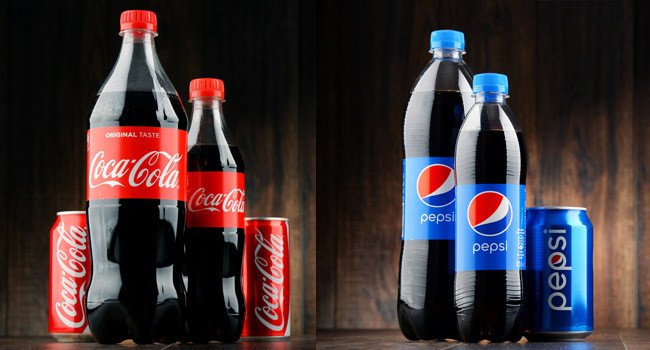
Marketing has also become a defining factor. Coca-Cola leans on big emotional campaigns and global sports sponsorships, while Pepsi appeals to youth and pop culture, sponsoring Nigerian music stars, concerts, and football events. As a result, Coke is often seen as the “family drink,” while Pepsi is regarded as the “party drink.”
Despite Pepsi’s aggressiveness, industry reports suggest Coca-Cola still holds the larger share of the Nigerian cola market, controlling roughly 60 to 65 per cent, with Pepsi around 30 to 35 per cent. Pepsi’s share is higher in urban centres where pricing and promotions sway younger buyers. The overall Nigerian carbonated soft drink market is worth billions of naira annually and continues to expand as urbanisation and a young population drive demand.
This Nigerian struggle is part of a much bigger global cola war that has raged for over a century. Coca-Cola, which operates in over 200 countries, is the clear global leader, selling an estimated 1.9 billion servings of its drinks every day. As of September 2025, The Coca-Cola Company has a market value of around US$286 to 289 billion, making it one of the most valuable consumer goods companies in the world. PepsiCo, though slightly smaller in brand value, is still a giant with a market value of about US$190 to 195 billion, driven not just by its cola but by a diversified beverages and snacks portfolio. PepsiCo’s 2023 net revenue was over US$91 billion globally.
Globally, Coca-Cola tends to dominate in most countries, particularly in the United States, much of Europe, Asia, and Latin America. Its heritage, deep distribution networks, and massive marketing budgets give it an advantage. But there are important exceptions where Pepsi has either edged out or matched Coca-Cola. In Mexico, Pepsi has historically held an upper hand in the cola segment, driven by strong consumer loyalty and early distribution ties. In India, Pepsi has been highly competitive, especially among younger consumers and in certain flavoured cola segments, sometimes nearly doubling Coke’s share in specific categories. In countries like Pakistan, Saudi Arabia, and Oman, Pepsi has also held significant leads, showing that local taste preferences, bottling partnerships, and aggressive pricing can tip the scales. In some of these markets, consumers prefer Pepsi’s sweeter profile, while in others, promotions and distribution strategies made it more accessible.
The global cola war is shaped by local tastes and economic realities. In Nigeria, inflation and rising costs mean consumers are increasingly price-sensitive, pushing both brands to introduce smaller, more affordable packages while also experimenting with zero-sugar options to cater to health-conscious buyers. Abroad, the same logic applies but with different cultural flavours. Pepsi is often seen as youthful and edgy, while Coca-Cola presents itself as timeless and family-oriented.
Ultimately, the rivalry is not just about who sells more bottles but about who can remain closest to the people. In Nigeria, Coke’s entrenched network and brand loyalty give it the edge, but Pepsi’s clever pricing and youth-driven marketing continue to win converts. Globally, Coca-Cola remains dominant, but Pepsi has proven that with the right mix of strategy, pricing, and cultural resonance, it can topple the giant in certain countries. The cola war is less a battle with a clear winner than a never-ending contest, and in places like Nigeria, it plays out every single day in the hands of consumers deciding which bottle to grab from the cooler.
“I’ve been in this business for over 20 years,” said Chinedu Okonkwo, a distributor in Onitsha, Anambra State. “Coke moves faster in the East because people see it as the original, but when Pepsi drops its price, young boys rush it. The battle is real, and as a distributor, I just make sure I stock both.”
In Lagos, Maryam Ibrahim, a shop owner in Surulere, explained how consumer choice shifts with promotions. “If Pepsi is doing their buy-one-get-one or giving bigger bottles at the same price, I sell out in days. But during festive seasons, Coca-Cola is king because families want it for ceremonies.”
From the production side, a senior staff member at the Nigerian Bottling Company in Ikeja emphasised Coke’s edge in infrastructure. “We have invested heavily in plants and trucks. That’s why even in rural towns, you will find Coke cold and available. That is what keeps us ahead.”
But Pepsi counters with youth loyalty. A Pepsi franchise retailer in Kano, Mallam Sani, put it plainly: “Here, students love Pepsi. They say it tastes sweeter, and they get more volume for their money. We sell Coke too, but the young people are Pepsi’s soldiers.”
Consumers themselves express the divide. Blessing Nwafor, a university student in Enugu, said: “Pepsi is my drink because I feel it’s for young people, and it fills me more. Coke is good, but it feels like something for my parents.” Meanwhile, an older consumer in Ibadan, Chief Adebayo, laughed as he opened a bottle of Coke: “Since I was a boy, Coke has been the drink. Pepsi comes and goes, but Coca-Cola is tradition.”
