


-
Hon. SEYI JAKANDE Tells City People
Not too many young people these days will know late Alhaji Lateef Jakande. He was the Executive Governor of Lagos State fom 1979 to 1983. He remains one of the most outstanding administrators to ever take charge of Lagos State. He introduced the free education system that changed the face of education in Lagos state. Most parents in Lagos at the time will remember him as the man whose educational policies enabled them to send their wards to school for free. Today, a lot of distinguished men and women in the society stand tall and proudly to speak of how Jakande’s free education gave them the privilege to go to school and become the accomplished personalities they have become today.
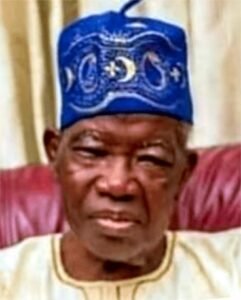
But the big news here is that one of late Alhaji Lateef Jakande’s sons, who’s also a politician like his father, is making a modest impact at the grassroots level. His name is Honourable Seyi Jakande and he’s the current vice Chairman of Odi-Olowo/Ojuwoye LCDA. In a couple of months from now, the local government elections would be held and Hon. Seyi Jakande is vying for the position of chairmanship of the Odi-Olowo/Ojuwoye LCDA. His principal, the current chairman of the LCDA, Hon. Rasaq Olusola Ajala would be rounding off on his tenure by the time the elections would take place.
The excitement at the secretariat and indeed in the whole of Odi-Olowo Ojuwoye right now, in anticipation of Hon. Seyi’s emergence as the next duly elected Executive Chairman of the LCDA, is palpable. You could feel it the moment you step inside the secretariat. This is because everyone agrees that Hon. Seyi is the appropriate and deserving successor to the curent Chairman. He is brilliant. He is very proactive. He has also garnered a lot of experience as vice chairman to Hon. Ajala. Many also are impressed with the fact that he served his principal, Hon. Ajala diligently and showed him total loyalty, which is why they both share a very close relationship till date. Hon. Ajala is also throwing his full weight behind his vice and is helping to ensure he succeeds him as the next Executive Chairman of Odi-Olowo/Ojuwoye.
Everyone loves Hon. Seyi mostly on account of his humility, something he obviously got from his father who was considered an extremely humble personality who never carried himself like he was any better than he next person.
The team of City People Senior Editor, WALE LAWAL (08037209290), WAHAB BASHIR, GM, Productions, TIMOTHY FOWOMOLA, Head of Projects and OLA SIMEON Online Editor, spent well over an hour engaging this young and promising politician who is brmming with ideas on how to take Odi-Oowo/Ojuwoye LCDA to the next level if elected the next Executive Chairman. He also shared with us some of the things he has been able to pick from his late dad and apply in his political journey so far. Enjoy excerpts.
Let me begin by saying that I am one of those who benefitted largely from late Lateef Jakande’s free education programme. He did very well. Now, I know you’re well aware of the pressure the legacies of your father puts on you because once anyone hears the name Jakande, what immediately comes to mind is integrity, hard work, outstanding performance, selfless service. So, tell us, how much pressure do your father’s legacies put on you?
Well, first let me start by thanking you as well, welcoming you, and also to let you know it’s also a privilege to have you here. It’s also a thing of joy that I’m talking to a product from Baba. People always say that Baba’s products are not only his biological children. Baba had a lot of children, because if you have through public service, established institutions, systems that have to bring up people who are in various fields and putting all these things together, I think it’s actually a good feat. So, I’m glad, and I’m happy to see, to witness some of his good deeds while he was here. I will say that you also were sending me more like a message to show appreciation to him. I will say that in showing appreciation to Baba, I think the greatest way we can actually appreciate what he has done is for us as a people to collectively come together and start to give back to society what we have gotten from him in all areas of life.
If somebody in his own wisdom has decided that his chosen path to follow is that of service to the people and being selfless, he then puts all his attributes together, but he left one that was very key and fundamental, which is contentment, right? Because, you see, you can’t give if you are greedy. You know, Baba was very content and I think that was a guiding principle behind his success because, you see, when you want to deliver service to people, you can’t think about yourself. The people must come first. It’s a responsibility that you have taken upon yourself to deliver. If you want to think about yourself, you stay in your private capacity, then nobody measures you apart from your family and your stomach. But when you’re going out to the public, you must put that aside and see that your scale of measure is within what you are doing to the public. You have increased the size of what you need to give.
You must also be very conscious that you are not giving people from your personal pockets. You have been entrusted with funds to help to make decisions to create value for the real genuine owners of this fund, which is the public. It’s just like putting money in a trust fund where you expect some form of quality of life, some form of quality of interest to get to you. So you must look at things from that perspective, and I think that is exactly what Baba has done.
So, going back to your question about the pressure Baba’s legacies put on my shoulders, I’ve tried to give you a preamble so that you can understand. From what I’ve said, you can now answer the question. I think that from trying to emulate Baba’s legacy, from you using your vantage position of who you are, being somebody that has benefited from Baba’s system of governance, and somebody is now mandating you that you must also do the same, so you look at that pressure, how it’s facing you physically, and you ask yourself, what are the immediate steps you must take? I can understand that the first reaction might be for the person to be sweating in an air-conditioned room because when you look at it, for me to be like Baba Jakande, that’s a very big shoe to wear. But we as his children and as his family, I believe that Baba made it quite easy for us. And I would say that with all sense of responsibility, that he made it quite easy for us to be able to emulate Him, for us to be able to follow his path.
You know, it’s easy because of his ways and mode of leadership. He was always leading by example. Transparent leadership. I see us as taking the theoretical knowledge from Baba following the footsteps of Baba and then we see the practical, what he’s doing outside. So, everything he has demonstrated in the public space is what he has taught us in his private space. So, it’s easy. He was an open book.
He didn’t have to come back home and explain himself and say, so, what you saw yesterday at the state house, you know, was a political statement. It’s different from what I’ve been telling you. He never said such to us. So, it was quite easy for us. But then, we can’t take away the pressure that comes with his legacies. What we have learned from it is to understand the main quality of recognizing your person, which is not literally attached to only being a Jakande. I think that relates to every human being, to have a self-assessment of your person. To know who you are.
At what point did you realize that you were going to toe Baba’s line? I ask this question because, with the little I know of him, I can’t picture him sitting his kids down to say, you must follow my footsteps and become a politician, it doesn’t fit into the kind of personality we knew of him. So, at what point did you realize that this was the line you were going to follow?
So, again, yes, you’re right. Baba was very liberal. He never dictated to us. We had the liberty to choose our various chosen fields of career. Of course, he would give you a guide, give you advice, but, you know, you have the absolute choice at the end of the day. He was liberal when it comes to religion. It should interest you that half of his children are Christians, half are Muslims. Yes, he was an Alhaji, his wife was an Alhaja. All of us went through the Quranic schools growing up, but it gets to a point you have the liberty to take the decision of what religion you want to go with. You know, so in terms of choice of decisions and all of that, he’s very, very liberal. And you asked at what point? Personally, in my opinion, from experience with Baba, I don’t see politics the way it’s being done now. I don’t think politics should be a career.
Just like when people try to abstain from politics and say, no, no, no, these are politicians, don’t mix with them, all politicians are liars. They play dirty politics and all of that. There’s nothing like dirty politics. What we have is dirty people playing politics in their own dirty ways. So, there are classifications. But you see, we are all just all surrounded with all of those words that only exist within our own space and people now are used to it, and that gives credit to where we now have this voters apathy because some people believe politics is for crooks and hooligans. And then a few people are left with the responsibilities to decide what happens to the vast majority of Nigerians, it shouldn’t be like that. We all have a responsibility to collectively participate in the process of moving the country forward.
