

…To Celebrate End Of RAMADAN
Zakat al-Fitr is a Special Ramadan Zakat and mandatory religious tax paid by those who can afford it at the end of the month of Ramadan. It is paid based on the type of major item of food consumed by the believer during the year. This may be rice, wheat, barley, dates, etc. It should be paid per person. It is also permissible to pay cash of equivalent value.
Zakat al-Fitr which is also called Sadaqat al-Fitr is a noble tradition in Islam where Muslims upon completing the 29 or 30 days of the annual Ramadan fasting month give alms. It is a mandatory charity due on every Muslim at the end of Ramadan, regardless of age or gender.
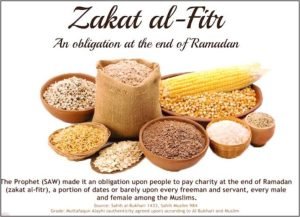
The Companions of the Prophet, on him be peace, report that Prophet Muhammad (Peace Be Upon Him), “imposed” the Zakat of Fast-Breaking [at the close of Ramadan] at the measure of one sa‘ (4 double-handfuls) of dates or one sa‘ of barley, on every Muslim, free or bondsman, male or female.
Zakat al-Fitr is paid to fulfil 2 primary purposes; one is spiritual for the individual worshiper and the other is communal.
The spiritual implication of giving Zakat al-Fitr at the end of the month-long fast is to cleanse and amend the faster’s mistakes or purifies his or her fast from moral contaminants.
Zakat al-Fitr’s communal relevance is appreciated because it provides the fasting and believing poor with the food items to whole-heartedly glorify God, celebrate the Eid Prayer, and share the day’s merriment and delight with their children and families. The Prophet, on him be peace, famously said in this regard: “Gratify [the poor] on this day”
Giving Charity in form of Zakat al-Fitr is a universal Muslim obligation. And every Muslim is liable for its payment. In the words of Abu Hurayrah, it is due on “every Muslim, free or bondsman, male or female, young or old, poor or rich” (Bukhari). If children possess wealth, Zakat al-Fitr comes out of their individual holdings, otherwise the child’s guardian pays on behalf of his son or daughter. This does not include the unborn child still in the womb. The only exemption is for one who does not possess food sufficient for the day of Eid, shelter, clothing and similar essentials.
Traditionally Zakat al-Fitr restricted its payment to food items. But today, payment in value is now widely accepted among Muslims, with many Zakat-collecting agencies converting that currency payment into foodstuffs for distribution at the time of Eid to the destitute, refugees, the displaced and the egregiously poor.
Rich Muslims are encouraged to pay more than the minimum Zakat al-Fitr required, if one is able. “Ali, God be pleased with him, reportedly said that ‘when Allah gives you prosperity, you too should give more’.
Zakatul Fitri is due to be the sunset of Ramadan’s last fasting day and the latest before the Eid Salah-Prayer. All scholars deem it sinful to delay its payment until after Eid day. Paying Zakatul Fitri late will ensure the happiness and distribution to the poor on Eid day, for their gratification, in compliance with the Prophet’s instruction, on him be peace.
All Muslim scholars also agreed that poor Muslims are legitimate recipients of Zakat al-Fitri. A poor individual may also receive Fitri payments from more than one giver, without restriction, though scholars dislike dividing a single payment among many recipients, as it seems to undo Zakat al-Fitri’s objective of sufficing a poor person on the day of Eid.
It is important to note that Zakat al-Fitri cannot be given to people for whom the payer is already responsible, such as a man’s wife, child, parents and so on or to disbelievers or the wealthy. It can be given to the poor and needy alone, or all eight Zakat categories such as: the poor, the needy, those who are involved with its work, reconciliation of hearts, the slaves, the indebted, in the way of Allah and the wayfarer. So, it is a choice for the giver to make.
