

-
The Story Of The Cross-Party Political Group
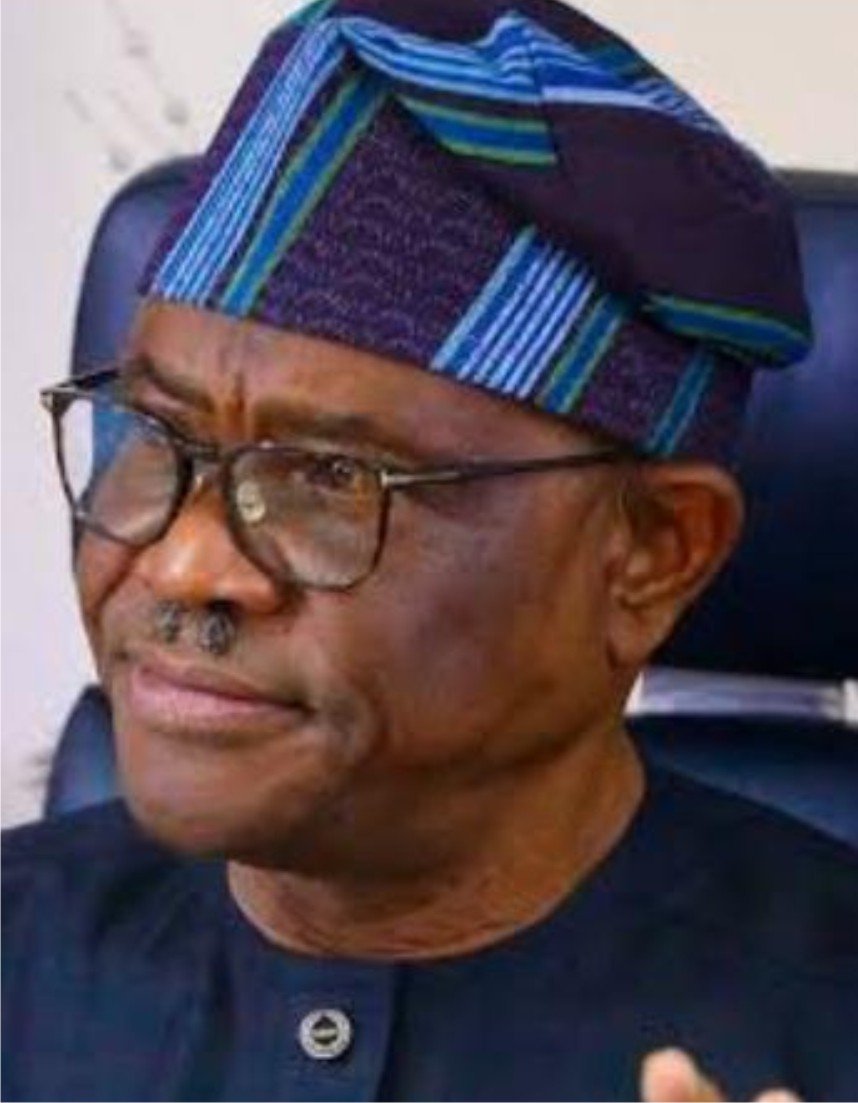
The political calculations ahead of Nigeria’s 2027 general elections are becoming increasingly complicated, with former Rivers State Governor and Minister of the Federal Capital Territory, Nyesom Wike, emerging as one of the key figures behind a growing political realignment in support of President Bola Ahmed Tinubu.
What Wike has increasingly described as a “Rainbow Coalition” is no longer simply a Rivers State arrangement. In his latest public comments, he suggested that the coalition supporting Tinubu will become broader, bringing politicians from different parties and political tendencies into a common platform ahead of the presidential election.
Speaking in Abuja on 21st August, 2026, Wike predicted a much larger national coalition for Tinubu and argued that more politicians would join the emerging political alignment. He also referred to the recent political developments involving Osun State Governor Ademola Adeleke as part of the wider realignment.
The development is significant because Wike himself remains associated with the Peoples Democratic Party (PDP), while President Tinubu is the leader of the All Progressives Congress (APC). Rather than waiting for every member of his political network to formally cross over to the APC, Wike appears to be pursuing a broader arrangement in which politicians can retain their individual political identities while working toward a common presidential objective.
The central idea appears straightforward: bring together politicians who may belong to different political parties but share an interest in supporting Tinubu’s re-election in 2027. This explains the choice of the word “Rainbow”. A rainbow is made up of different colours, and Wike’s political coalition is similarly designed to accommodate different political interests.
The arrangement is therefore different from a conventional party merger. A politician does not necessarily have to abandon his or her party before participating in the coalition. This strategy could be particularly useful in states where the APC does not possess sufficient political strength on its own, but where influential politicians from the PDP, Labour Party and other parties may be prepared to work with the Tinubu administration. The Rivers experience provides the clearest example.
In May, Wike said the Rainbow Coalition in Rivers comprised four political parties — the PDP, APC, Labour Party and Action Alliance — and that the coalition would collectively determine its candidate for the 2027 governorship election. That model provides an insight into the broader political philosophy behind Wike’s strategy.
WIKE’S BIGGEST POLITICAL ASSET:
HIS NETWORK
Wike’s greatest strength is arguably not his formal position as FCT Minister but his extensive political network. The former Rivers governor has maintained relationships with politicians across party lines, particularly within the PDP. He was one of the five governors known as the G5 during the 2023 presidential election. The group openly opposed the PDP’s presidential campaign under Atiku Abubakar and insisted that the party’s leadership structure had failed to respect its internal power-sharing principles.
The political consequences of that confrontation have continued long after the 2023 election. Wike subsequently accepted appointment into President Tinubu’s administration as FCT Minister, despite remaining publicly associated with the PDP.
That unusual political position has given him access to two political worlds — the ruling establishment and sections of the opposition. The Rainbow Coalition can therefore be seen as an attempt to convert that unusual position into a broader political structure.
FUBARA’S RETURN TO THE POLITICAL FAMILY
One of the most important developments in the Wike project has been the reconciliation between Wike and his successor in Rivers State, Governor Siminalayi Fubara. For months, their relationship was at the centre of one of Nigeria’s most intense political crises. The conflict divided political actors in Rivers and threatened to reshape the balance of power in the state. But by July 2026, the two men had publicly reconciled. Fubara subsequently declared his support for the Rainbow Coalition and President Tinubu’s second-term bid. He also endorsed Kingsley Chinda in the Rivers governorship race.
Wike described Fubara’s return to the political family as a major development and argued that the reconciliation would strengthen the political structure supporting Tinubu in 2027. This reconciliation may prove to be one of the most important building blocks of the Rainbow Coalition. The message is clear: the Wike camp wants to enter 2027 without the internal war that weakened its political structure in Rivers.
RIVERS AS THE LABORATORY
Rivers State appears to be the laboratory where Wike’s coalition strategy has been tested. The coalition is designed to bring together politicians who may ordinarily compete against one another under different party platforms. Instead, the emphasis is on agreeing on common candidates and political objectives. Wike stated in May that the coalition had not yet selected its governorship candidate and that the decision would be collectively made.
This is important. It suggests that the coalition is not simply a presidential support group. It is also attempting to influence governorship and legislative contests. That could make it a much more powerful political machine. If successful, the structure could operate at three levels: Presidential level: Support for Tinubu. Governorship level: Agreement on candidates acceptable to the coalition. Legislative level: Coordinated support for senators, House of Representatives members and state Assembly candidates. Such an arrangement could transform the Rainbow Coalition from a loose political alliance into a serious electoral organisation.
WHY TINUBU NEEDS THE RAINBOW COALITION
For President Tinubu, the attraction is obvious. A successful coalition would reduce the importance of party labels in several politically important states. Instead of fighting every election as APC versus PDP, Tinubu’s camp could potentially enter 2027 with influential politicians from both sides of the traditional political divide working toward his re-election. This is particularly important because the opposition is simultaneously attempting to build its own coalition. The opposition’s difficulty in settling on a single presidential candidate creates an opening for Tinubu’s camp. Wike appears determined to exploit that opening.
THE PDP PROBLEM
The Rainbow Coalition also reflects the continuing crisis within the PDP. The PDP remains one of Nigeria’s most important political parties, but its internal divisions have severely affected its ability to present a united national opposition. The Wike faction’s refusal to participate in certain opposition coalition arrangements has further complicated the opposition’s efforts to build a single front against Tinubu. Wike’s political calculation appears to be that the PDP’s internal divisions cannot simply be ignored. Instead, he wants politicians who share his political interests to work with Tinubu, regardless of whether they remain formally inside the PDP. This explains why his coalition could become a major factor in the 2027 contest.
THE G5 LEGACY
To understand today’s Rainbow Coalition, it is necessary to go back to the G5. The five governors — Wike, Seyi Makinde, Samuel Ortom, Okezie Ikpeazu and Ifeanyi Ugwuanyi — became one of the most powerful anti-Atiku blocs within the PDP before the 2023 election. Their disagreement with the PDP presidential leadership contributed to the party’s internal crisis. Four years later, the political consequences of that episode remain visible. Wike has effectively moved from leading a faction inside the PDP to building relationships beyond the PDP. His political philosophy appears to have evolved from intra-party resistance to cross-party bargaining. That is the essence of the Rainbow Coalition.
WHAT WIKE IS REALLY BUILDING
Beyond the rhetoric, Wike appears to be building something more sophisticated than another political party. He is attempting to create a network of political relationships. The network could include: politicians who remain in the PDP; APC members; politicians from smaller parties; governors seeking cooperation with the Federal Government; former governors; legislators; political godfathers and grassroots operators; former opposition figures; and influential politicians who may not want to publicly defect but are willing to support Tinubu. This is why the Rainbow Coalition is potentially different from a normal political alliance. It is less about uniformity and more about coordination.
The ultimate target: 2027
At the heart of the entire project is one objective — to make President Tinubu’s re-election easier by preventing the opposition from consolidating its political strength. Wike’s public statements suggest that he believes more politicians will eventually move toward Tinubu. His argument is that the opposition is too divided to defeat the incumbent. The opposition, however, is also attempting to build a counter-coalition involving major political figures. That means 2027 may not ultimately be a simple APC-versus-PDP contest.
It could become a contest between two broad political networks, with traditional party identities becoming less important. One network will be built around Tinubu and the APC, with Wike’s Rainbow Coalition potentially providing a bridge to politicians outside the ruling party. The other will attempt to unite opposition politicians around a single presidential challenger.
A NEW POLITICAL ARCHITECTURE
What is unfolding around Wike is arguably part of a broader transformation of Nigerian politics.
The old assumption that politicians must remain permanently attached to one political party is being challenged.
Politicians increasingly appear prepared to negotiate across party lines based on immediate political interests, federal relationships, local power structures and future ambitions.
Wike is positioning himself at the centre of this new arrangement.
His Rainbow Coalition is therefore not merely about Tinubu.
It is also about who controls the political structures that will determine Nigeria’s post-2027 political landscape.
For Tinubu, the coalition could provide additional political strength.
For Wike, it could consolidate his influence beyond Rivers State.
For politicians from the opposition, it provides a route to cooperate with the Federal Government without necessarily abandoning their existing party structures.
And for the Opposition, it represents another warning that the battle for 2027 will not be fought solely on the traditional APC-PDP battlefield.
