

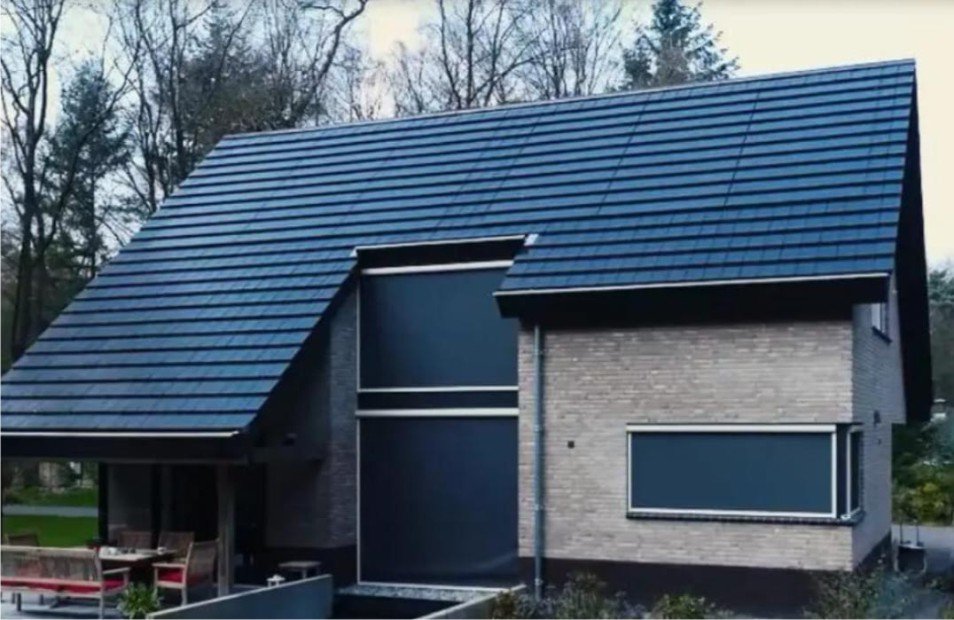
Nigeria’s housing sector is evolving daily. Builders and Real Estate developers are embracing innovation and technologies that make housing more homely and pleasing. Some of these houses, now with significant technological advancements, are called smart or luxury homes.
In today’s housing market, luxury homes must include basic amenities, one of which is the newly introduced solar roofing sheets.
Currently, most homeowners first install conventional roofing sheets before later attaching solar panels to the roof structure. In many cases, large sections of rooftops become completely covered with mounted solar panels. This practice often requires additional support structures, specialised installation, regular maintenance, and sometimes repeated movement across the roof surface, which may affect the longevity of the roofing system.
This situation raises an important question: Why should roofing sheets and solar panels remain separate products when they can be integrated into a single roofing solution? The answer lies in the emerging global technology known as Building-Integrated Photovoltaics (BIPV), where solar cells are incorporated directly into building materials, including roofing sheets, tiles, facades, and windows. Instead of mounting solar panels on an existing roof, the roof itself becomes a power-generating asset.
Although Building-Integrated Photovoltaics (BIPV) technology has begun to make inroads into Nigeria’s commercial Real Estate sector, its application remains largely limited to corporate and institutional buildings. One of the most notable examples is the headquarters of one of the foremost commercial banks in the country, which has been transformed into one of Africa’s pioneering solar-powered towers through the integration of photovoltaic panels into the building’s façade and structure. Similar integrated solar solutions have also been introduced in commercial facilities, office complexes, and solar-powered car parks. However, the technology is yet to gain traction in Nigeria’s residential housing sector, where conventional roofing sheets continue to dominate despite the growing adoption of rooftop-mounted solar panels.
For Nigeria, this innovation could revolutionise both housing construction and renewable energy adoption. The need for alternative energy solutions has never been more urgent. The 2024 Nigeria Demographic and Health Survey revealed that only about 51 percent of Nigerian households have access to electricity. This means that nearly half of the country’s households still lack reliable power supply, forcing many families and businesses to depend on generators, rechargeable devices, and alternative energy sources. Recent studies further highlight persistent energy poverty and infrastructure deficits across the country.
At the same time, solar energy adoption is gaining momentum. Reports indicate that Nigeria has become one of Africa’s fastest-growing solar markets, with increasing imports of solar panels and expanding demand for solar-powered homes, farms, schools, and businesses. The country’s abundant sunshine provides a natural advantage for solar energy generation throughout the year.
However, despite this growth, the majority of solar installations still rely on imported panels mounted on traditional roofs. The integration of solar technology into roofing sheets offers several advantages.
First, it reduces installation costs. Homeowners would no longer need to purchase roofing materials separately and later incur additional expenses for mounting solar panels. A single product would serve both functions.
Second, solar roofing sheets would improve aesthetics. Many modern buildings currently have large arrays of panels attached to rooftops, often creating an uneven appearance. Integrated solar roofs provide a cleaner and more attractive architectural finish.
Third, they enhance durability. Frequent movement on rooftops during panel installation and maintenance can damage roofing sheets. By embedding solar technology during manufacturing, the need for additional roof-mounted structures is significantly reduced.
Fourth, integrated solar roofs can increase property value by combining energy generation with modern building design.
Fifth, local production would stimulate industrial growth, create jobs, reduce dependence on imports, and encourage technology transfer within Nigeria’s manufacturing sector.
Meanwhile, the global market for Building-Integrated Photovoltaics continues to expand as countries seek cleaner energy solutions and more efficient building designs. Researchers have demonstrated the enormous potential of rooftop-integrated solar systems for electricity generation, while industry reports identify roofing products as one of the most competitive and commercially promising segments of the BIPV market.
Building-Integrated Photovoltaics (BIPV) are dual-purpose construction materials that serve as both the exterior skin of a building and a renewable energy generator. Unlike traditional solar panels attached to a finished roof, BIPV materials replace conventional elements like facades, skylights, windows, and roof tiles.
Building-integrated photovoltaics (BIPV) are photovoltaic materials that are used to replace conventional building materials in parts of the building envelope such as the roof, skylights, or façades.[1] They are increasingly being incorporated into the construction of new buildings as a principal or ancillary source of electrical power, although existing buildings may be retrofitted with similar technology. The advantage of integrated photovoltaics over more common non-integrated systems is that the initial cost can be offset by reducing the amount spent on building materials and labor that would normally be used to construct the part of the building that the BIPV modules replace. In addition, BIPV allows for more widespread solar adoption when the building’s aesthetics matter and traditional rack-mounted solar panels would disrupt the intended look of the building.
While upfront costs are significantly higher than both traditional building materials and standard roof-mounted solar panels (BAPV), BIPV saves money by offsetting the cost of standard exterior materials and utilizing previously unused surfaces.
Isaac Abimbade
08155107955
