

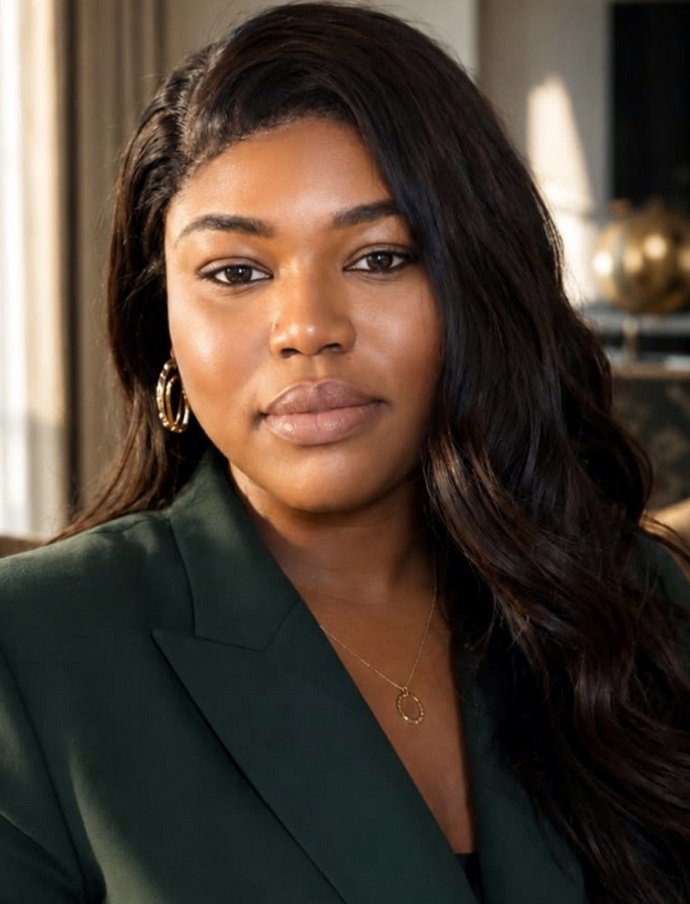
Bisola Animashaun is the co-founder of Luxury Shortlets, a fully furnished high end apartment/ homes for short stays in both Lagos and Abuja, which she runs with her sister, Bukola. The business, which operates over a thousand apartments, with several thousand visitors /clients yearly, is today regarded by industry watchers as one of the biggest in the hospitality sector. Having taken a substantial share of the market in both the FCT and Lagos, the sisters have moved a notch higher thus their entrant into the lucrative Africa Tourism market. The duo are currently out with STAY AFRIK, a tourism company redefining how the world experiences Africa. Stay Afrik curates authentic, immersive travel experiences designed specifically for international tourists who desire culture and heritage, adventure and luxury across the continent.
With a passion for storytelling, community impact, and showcasing Africa beyond the stereotypes, Bisola and her sister are on a mission to make travelling in Africa seamless, safe, and unforgettable for global visitors. In this interview with City People Editor, WOLE ALAKIJA, Bisola reveals why she and her sister are changing the narratives in the African Tourism sector… Enjoy it.
What gap in African tourism is Stay Afrik setting out to fill?
The gap isn’t in Africa’s offering. It’s in the confidence gap between what’s out there and what people abroad feel comfortable booking. Every major tourism boom in history has the same underlying pattern: a market becomes desirable long before it becomes trusted. That’s exactly where Africa sits right now. Nigeria is the clearest example. Our tourism sector currently contributes less than five per cent to GDP, even though we sit on more culture, history and landscape than most countries could dream of. The government has set a target of doubling that to ten per cent, and there’s real movement now, more than there was 5 years ago. But it’s still a fraction of what countries with far less raw material have built. Stay Afrik is built to close that gap. Not by inventing something new but by applying a level of discipline that neither the continent nor Nigeria has ever had the infrastructure to apply at scale.
What makes Stay Afrik different from other African travel companies already targeting international tourists?
Most companies in this space are marketing-led. They sell a feeling and hope operations catch up. In Stay Afrik, we’ve built the opposite way. We learned everything we know about earning a stranger’s trust in an unfamiliar space the hard way, by running one of Nigeria’s largest shortlet operations. That operational DNA isn’t something you can copy from a brochure. There are already good companies doing pieces of what we’re building, and we’re not trying to out-compete any of them head-to-head. What we’re focused on is depth: the level of research and standard behind each experience, not the size of the market we’re chasing.
What is your 3-5 year vision for Stay Afrik?
I want Stay Afrik to be the first name that comes to mind when someone abroad decides they’re finally taking that Africa trip. Not one country, not one experience, a trusted gateway into the continent. In 5 years, I want us known the way people know certain travel brands for Southeast Asia, except this time the story is being told by Africans, for the world, on our own terms.
Which African countries and experiences do you want to be known for in the next few years?
We’re sequencing this deliberately rather than announcing it all at once. That’s part of the strategy, not something I’ll get ahead of publicly. What I can say is that Nigeria’s own energy, particularly what December in Lagos represents, is a story that’s been sitting right in front of the world, completely unpackaged.
What sets our research apart is that we don’t spend 5 days somewhere and call it homework. Travel for us has never just been a hobby. It’s been a discipline. We spend 3 weeks to a month in a place, living like locals rather than moving through it as tourists, because that’s the only way to actually understand what makes somewhere worth experiencing. In Egypt that meant a Nile cruise from Aswan to Luxor, weeks spent among the temples at Philae, Kom Ombo and Karnak, understanding how thousands of years of hospitality and storytelling still shape how Egyptians welcome visitors today.
Kenya taught us something people rarely associate with it. Most people hear Kenya and think only safari. What they miss is the coast. Mombasa and Watamu sit on the same stretch of Indian Ocean coastline that runs down through Zanzibar, and many Divers consider the reef systems there among the best in the world, alongside places like the Red Sea. Watamu alone protects over a hundred and fifty coral species and hundreds of species of fish and carries UNESCO Biosphere status. So Kenya isn’t a choice between city, beach and wildlife. It’s genuinely all three in one country, and almost nobody markets it that way.
Who is your ideal international tourist?
Two kinds of people, honestly. Diaspora travellers looking for a real, well-guided way to reconnect with the continent, not a watered-down version. And curious global travellers who are tired of the same 5 destinations and want something that actually changes how they see the world. Affluent Nigerians exploring their own continent properly for the first time matter to us too.
Are you targeting adventure travellers, luxury travellers, diaspora, cultural tourists, etc, and why?
Diaspora and culturally curious travellers first, because that’s where the emotional pull is strongest. People who already feel a connection just need someone trustworthy to make the trip real. I and Stay Afrik suits the bill. Luxury sits underneath that as the standard we hold ourselves to, and honestly the numbers justify the focus. Look at Seychelles,by the government’s own figures, tourism drives as much as seventy per cent of that country’s GDP and foreign exchange earnings. That’s built almost entirely on attracting a small number of high-net-worth travellers rather than chasing volume, proof that scarcity and precision can outperform scale. We’re not chasing the backpacker, budget-adventure market right now. That’s a different business, and trying to be everything to everyone is how quality dies.
How would you design an “African travel experience” that feels authentic but still comfortable, safe and affordable for a first-time international visitor?
Authenticity and comfort aren’t actually opposites. That’s a myth the industry has sold people. You can hand someone a genuine, unscripted experience while still making sure their accommodation is vetted, their guide is trustworthy, and someone is reachable if anything goes sideways. South Africa is probably the clearest proof of this. Cape Town alone sits inside the Cape Floral Kingdom, the smallest of the world’s six plant kingdoms and home to around nine thousand plant species found almost nowhere else on earth. That’s paired with world-class infrastructure, wine country and genuine comfort. It isn’t a contradiction. It’s what happens when a destination invests in both wild, untouched nature and the systems that let visitors experience it safely. That’s exactly what we did with Luxury Shortlets too. We didn’t strip the character out of a city to make it feel safe. We just made sure nothing was left to chance behind the scenes.
What are the biggest challenges of running tourism across multiple African countries: logistics, payments, visas, marketing, and how is Stay Afrik solving them?
Cross-border payments and logistics in Africa are genuinely difficult. Anyone who tells you otherwise hasn’t tried it. Our approach is partnership over control, working with trusted local operators in each market rather than pretending we can run everything centrally from Nigeria. Visa friction is something we can’t fully solve ourselves, but we make sure travellers know exactly what to expect long before they book so there are no surprises. As for marketing, that’s less a logistics problem and more a perception problem.
How do you work with local communities, guides, and vendors to ensure tourism benefits them directly?
We prioritise working directly with local guides and small operators rather than routing everything through big, extractive tour chains. In Kenya, I saw guides trained to be storytellers, not just drivers. I also saw how seriously coastal communities take reef conservation. Marine parks like Watamu exist because local and national stakeholders decided decades ago that protecting the reef mattered more than short-term extraction. That’s the kind of local expertise and stewardship that should be paid properly and credited, not treated as background scenery. If a community isn’t benefiting directly from tourism happening in their own backyard, something in the model is broken.
What role does tech play in your business, booking, payments, customer experience?
We’re building on the same instincts that shaped Luxury Shortlets systems: fast, direct communication, and real humans backing up the technology instead of chatbots pretending to care. Booking and support need to feel effortless for the traveller, even when there’s a lot of complexity happening behind the scenes to make that possible.
How do you market Africa to international tourists who may only know the “safari and poverty” narrative? What story are you going to be telling about Africa?
That narrative was written by people who were never trying to sell Africa to the world. They were explaining it to themselves. For decades, Africa’s story has been authored from the outside, packaged by people who don’t live here, then sold back to us as the definitive version of our own continent. Stay Afrik exists to flip that.
There’s a concept in communication theory called the two-step flow. Information doesn’t just move from a source to an audience; it passes through people and channels that shape how it’s understood along the way. Right now, that flow runs almost entirely in one direction. The average person in Lagos or Nairobi could probably tell you more about London, New York or Paris than the average person in those cities could tell you about any African capital. Some don’t even know Africa is a continent rather than a single country. That imbalance isn’t an accident. It’s the result of decades of one-sided storytelling, and it’s exactly what we intend to correct.
That’s why Stay Afrik isn’t only a booking platform. We’re also building a media arm, educational content across social media, search engines, AI platforms and other online and offline channels, covering different African countries, cultures and histories. It’s available to anyone, whether they can afford to book a trip this year or not. I’ve travelled enough of the world to say this plainly. Africa is one of the most breathtaking, untouched, achingly beautiful places on this earth, and it remains criminally under-celebrated for it. Some of the destinations the world lines up to photograph don’t hold a candle to what sits quietly, unpackaged, across this continent. It’s the version of hospitality Nigerians already extend to each other every single day, simply never marketed for an outside audience until now. Nigerians have mastered hosting each other. The next step is hosting the world.
