
+How Impoverished Youths Are Lured Into It
Ever wondered how the black market sale of human organs involving many young Nigerians lately operate? The underworld business is run by a Mafia Group cut across the length and breath of Nigeria and the problem, according to authorities, is getting from bad to worse. Commercial organ sale is illegal under the National Health Act 2014. Yet NAPTIP, the police, and health regulators say an underground market exists. Investigations and court records show the trade works in 4 layers:
Layer 1: The Recruiters, Young brokers in universities, job centers, IDP camps, and online. They post as “agents” or “HR”. Phrases like “urgent medical donors needed” or fake job adverts are common bait on social media .
Layer 2: The Facilitators, People posing as lab scientists or nurses run blood tests in unregistered labs. Once a match is found, victims are moved quickly.
Layer 3: The Clinics, Surgeries are not done in teaching hospitals. NAPTIP reports busts in unlicensed clinics, private homes, and in some cases, victims are moved across borders to countries with weaker regulation. There is no follow-up care.
Layer 4: The Buyers, Buyers are often wealthy Nigerians, Foreigners or patients from other African countries who want to skip the legal transplant waiting list.
A senior NAPTIP official who asked not to be named said: “It’s not one mafia boss. It’s a chain. Touts, fake medical staff, transporters, and corrupt middlemen who forge ‘family donor’ papers.” Doctors however warn the risks are severe like post-surgery infection, kidney failure in the remaining kidney, hypertension, and eventual death. Because the surgery is illegal, there’s no insurance, no records, and no care when complications start. Presently the average amout spent on dialysis in a government-owned hospital weekly by a sufferer of Kidney problem is about One Hundred & Fifty Thousand naira.
The Medical and Dental Council of Nigeria has sanctioned Doctors found culpable, with jail terms handed. The government’s position is clear, organ donation in Nigeria is only legal between relatives, with approval from a hospital ethics committee, and with zero payment. Legal transplant centers exist at LUTH, UCH, Aminu Kano Teaching Hospital and a few others. With unemployment high and cost of living rising, many see selling a kidney as the fastest way to pay school fees, medical bills, or fund a “japa” plan. Social media posts claiming “I sold my kidney and bought a car” have made the idea spread lately even as many young men are joining the outrageous fray.
But behind the booming trade is an illegal network. The black market kidney trade in Nigeria is an illegal and highly exploitative underground economy driven by intense economic hardship and criminal syndicates. Buying or selling kidneys is strictly prohibited under Nigerian law, and any monetary transaction beyond legitimate medical expenses is illegal. Despite these prohibitions, a shadow market persists, heavily concentrated around the Federal Capital Territory (FCT), Abuja, and neighbouring Nasarawa State.
Investigations and local reports have shown that desperate young men from low economic backgrounds are targeted by local agents. Donors have reportedly been paid anywhere from ¦ 1 million to ¦ 1.7 million (approximately $1,100) per kidney while the criminal organ-trafficking networks allegedly resell these harvested kidneys to wealthy buyers for N50 million to N70 million.
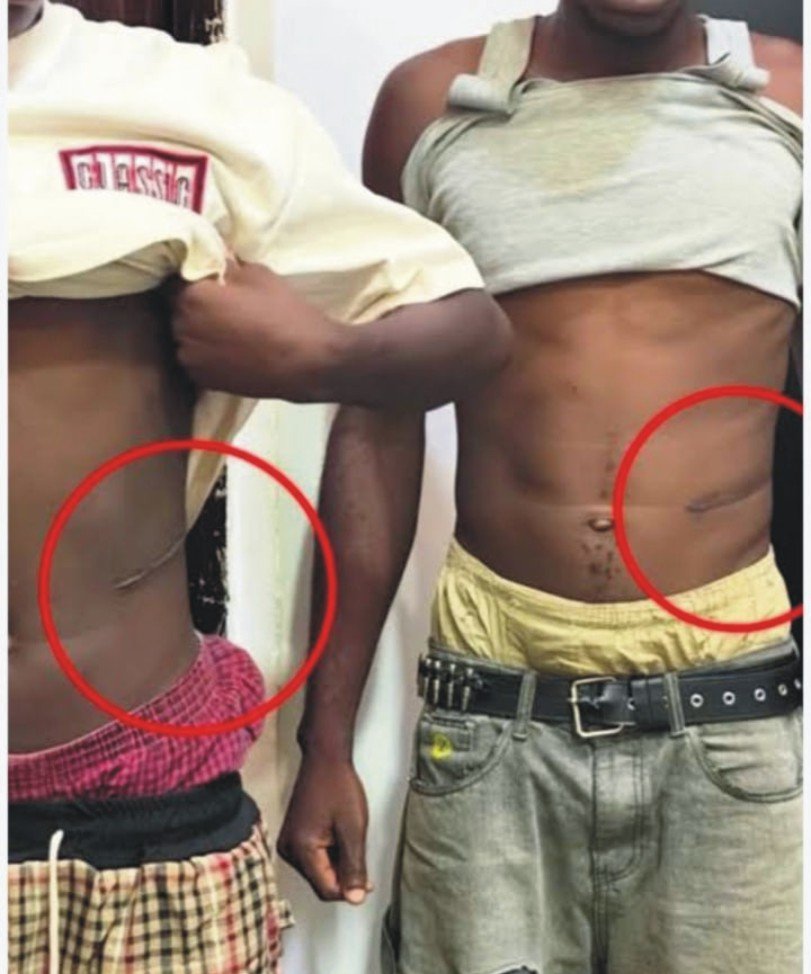
Kidney agents are planted within satellite communities such as Mararaba to lure impoverished youths.In some instances, victims have alleged that their kidneys were harvested without explicit consent during unrelated medical procedures, or that they were coerced by peers. In recent developments, police arrested multiple suspects including two medical doctors implicated in an organ-harvesting and human-trafficking network operating across Abuja and Nasarawa State.
Commercial organ sale is illegal under the National Health Act 2014. Legal transplants in Nigeria are only allowed between relatives, with ethics approval, and no payment. Doctors say the health risk is huge: infection, kidney failure, hypertension, and no follow-up care. NAPTIP has made arrests in Lagos, Abuja, Kano and Enugu in the last few months,with the latest being the Abuja/Nasarawa organ syndicate burst involving medical Doctors and young men,lured with a few dollars to part with their organs.
The answer most sellers give is the same, money ! Nigeria’s youth unemployment rate remains high. For many graduates,it is because of failed”japa” plans. For others, it’s debt — school fees, hospital bills, rent, or a failed business.
Social media has made it worse. Viral posts claiming “I sold my kidney and bought a car or finished my House” create the illusion that it’s a quick way out. Health experts say most of those posts are fake and created by the Mafia behind the organ business ,in cohort with their foreign counterparts mostly from South East Asia countries,where the demand for this delicate body organ is high.
Wole Alakija
08055001823
