


A proposed traditional appointment involving the Daura Emirate has raised questions after a senior representative who identified himself as the Chief Historian of Daura told an American-based Hausa claimant that approximately US$20,000 would be required to complete the traditional process leading to an appointment.
The discussion occurred during a WhatsApp conversation on September 4.
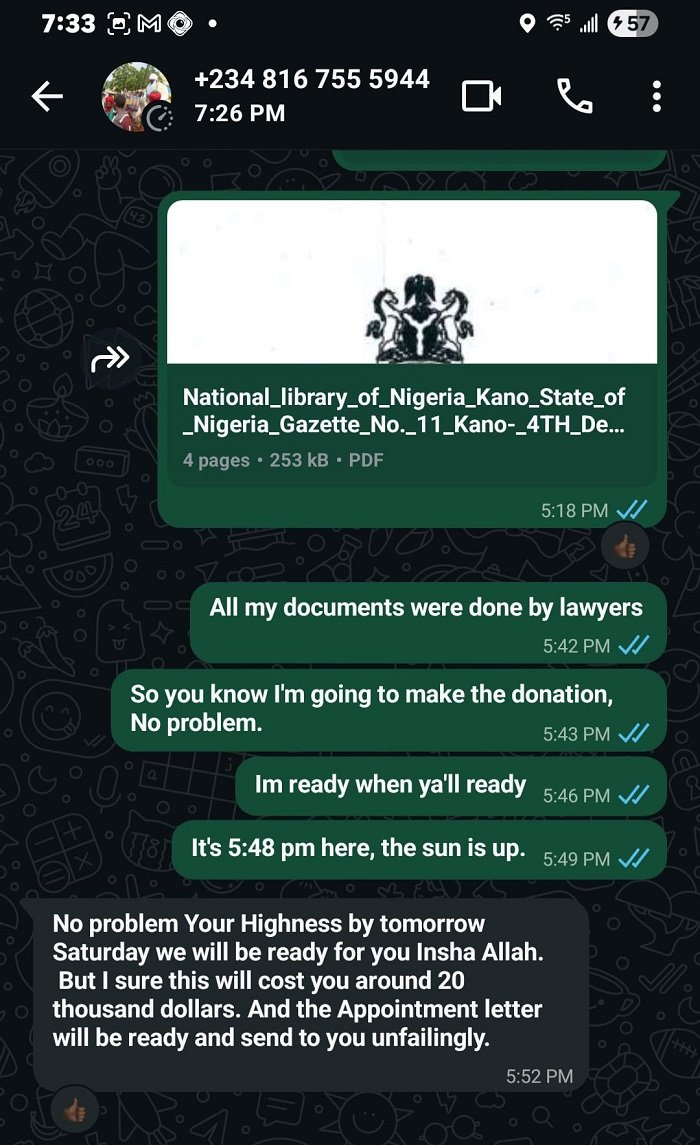
According to the messages made available to CityPeople, the claimant expressed his willingness to make a donation and said he was prepared to send funds. The Chief Historian subsequently responded:
“But I’m sure this will cost you around 20 thousand dollars. And the Appointment letter will be ready and sent to you unfailingly.”
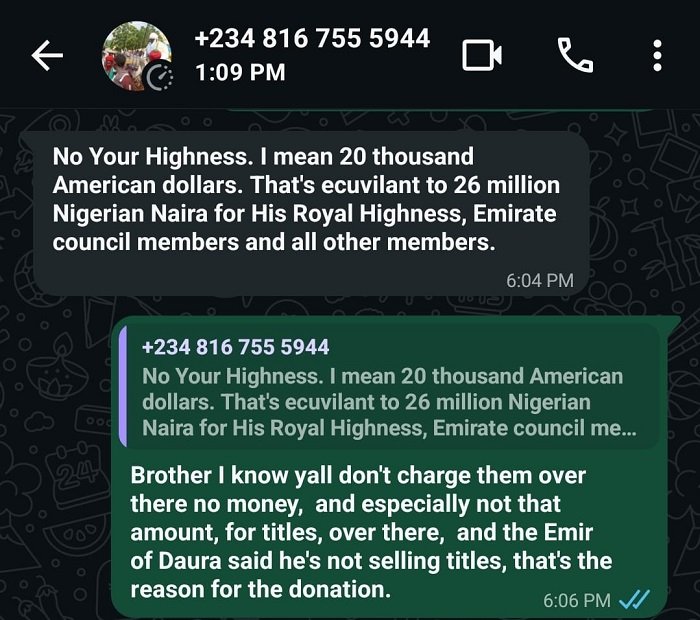
When the claimant asked whether the amount meant ₦20,000, the Chief Historian clarified:
“No Your Highness. I mean 20 thousand American dollars. That’s equivalent to 26 million Nigerian Naira for His Royal Highness, Emirate council members and all other members.”
The claimant questioned the amount and referred to public statements by the Emir of Daura concerning traditional titles and money.
The Chief Historian responded that the money was not payment directly to the Emir, stating:
“The money I mentioned is not for the Emir; it’s the traditional system for the Emirate.”
He further maintained:
“Yes, he is not selling titles, but the traditional process must be followed.”
Was the appointment approved?
The conversation took another significant turn when the claimant asked whether the Emir of Daura had approved the proposed appointment of Sarkin Hausawan North America.
The Chief Historian responded:
“Yes, of course, but only when traditional processes are followed.”
The statement appears to indicate that, according to the Chief Historian, the Emir had approved the proposed appointment subject to completion of the traditional process.
The claimant later asked whether the appointment would make him an Emir rather than simply receiving a traditional title.
The Chief Historian replied:
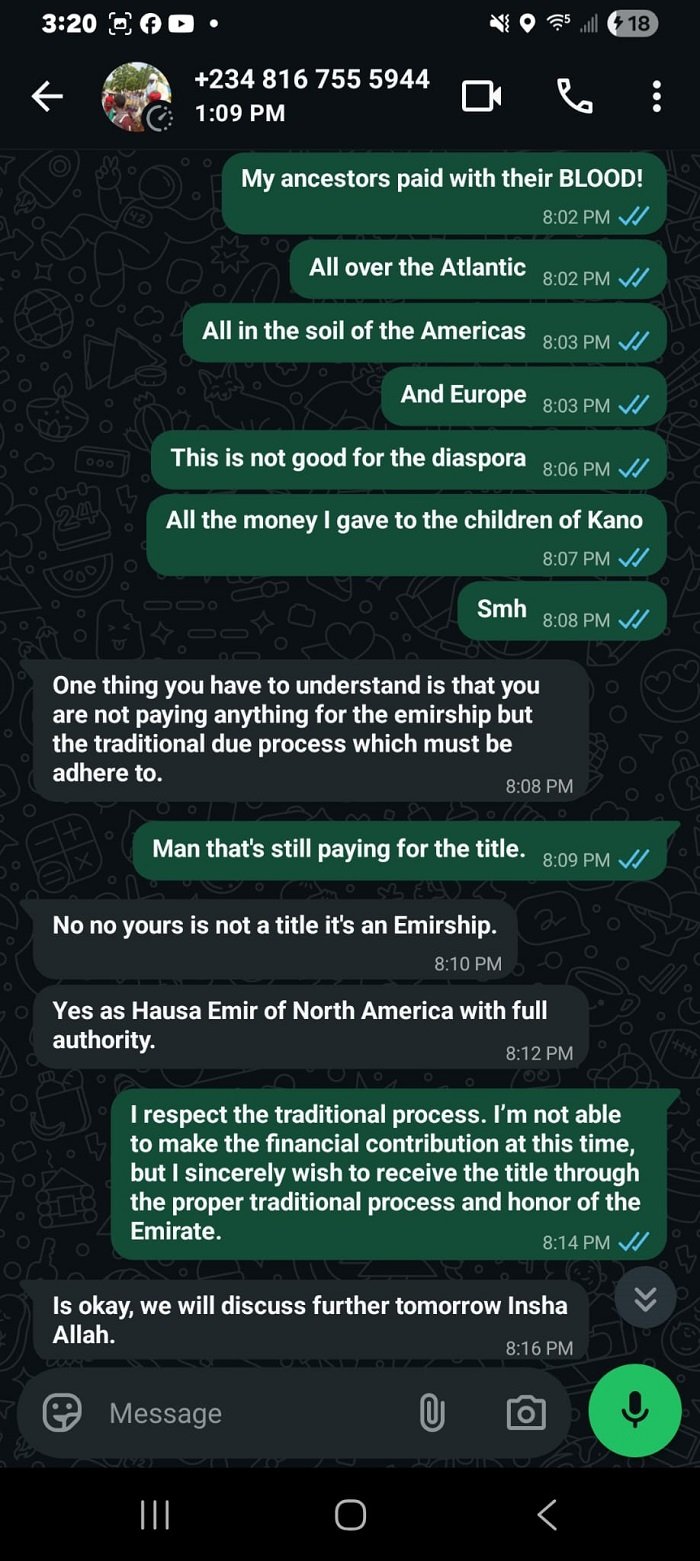
“No, no, yours is not a title; it’s an Emirship.”
He subsequently described the proposed position as:
“Hausa Emir of North America with full authority.”
The contradiction being questioned
The issue is complicated by public statements attributed to the Emir of Daura concerning the awarding of traditional titles.
In 2022, Nigerian media reported the Emir saying that Daura does not confer traditional titles because of money. PUNCH reported the Emir saying:
“Daura Emirate does not confer titles on people because of money.”
The Guardian similarly reported the Emir’s position that titles were not given because of money or position, but because recipients deserved the honour.
The apparent contradiction is therefore not necessarily that the Emir personally demanded $20,000. The available conversation does not establish that.
Rather, the question is whether a substantial financial payment described as part of the “traditional system” can be a required condition for completing an appointment that the Chief Historian says has already received the Emir’s approval.
“That’s still paying for the title”
The claimant directly raised that concern during the conversation.
After the Chief Historian explained that the payment was part of the traditional process rather than payment for the Emirship itself, the claimant responded:
“Man, that’s still paying for the title.”
The Chief Historian rejected that characterisation, responding:
“No no yours is not a title; it’s an Emirship.”
The claimant ultimately told him:
“I respect the traditional process. I’m not able to make the financial contribution at this time, but I sincerely wish to receive the title through the proper traditional process and honour of the Emirate.”
The Chief Historian responded:
“Is okay; we will discuss further tomorrow, Insha Allah.”
What remains unanswered
Several questions remain unresolved:
Is the approximately $20,000 an official requirement of the Daura Emirate?
What specific traditional expenses or obligations make up the $20,000?
Who officially established the amount?
Is payment mandatory before the appointment letter can be issued?
Did the Emir personally authorise the financial requirement?
If the payment is not for the Emirship itself, would the appointment proceed without it?
Is there an official written schedule of traditional dues applicable to such an appointment?
These questions are important because the Chief Historian himself distinguishes the arrangement from selling a title, while simultaneously telling the claimant that approximately $20,000 must be provided as part of the process before the appointment can proceed.
The claimant’s position
The claimant says he does not want to disrespect the Daura Emirate or accuse the Emir personally. His concern is the apparent difference between the Emir’s publicly reported position on money and what he was told privately about the proposed appointment.
He says he intends to be transparent with members of the press who had previously been informed that he expected to receive recognition from Daura.
At this stage, the evidence establishes what the Chief Historian told the claimant. It does not independently establish that the Emir personally ordered, requested, or knew about the $20,000 figure.
That distinction should remain central to any responsible reporting of the matter.
