

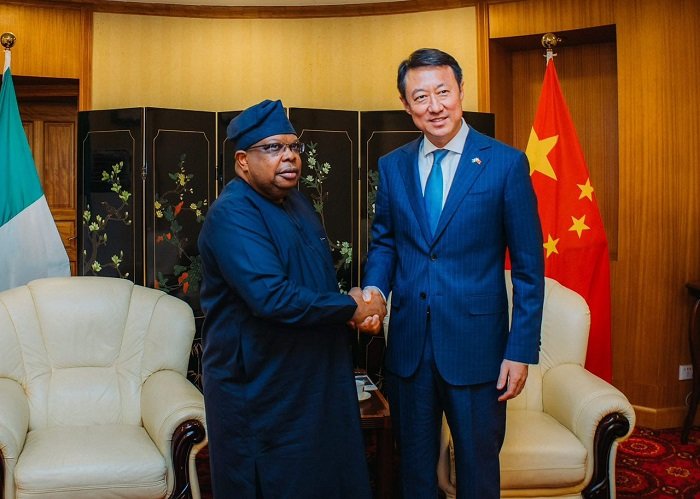
The massive influx of Chinese merchants directly into Nigerian retail markets, which has sparked localized protests like the “China-Must-Go” demonstrations at the Lagos International Trade Fair Complex recently is driven by a combination of domestic economic pressures in China, structural advantages in supply chains, and specific resources within Nigeria.
Do you know that Chinese population in Nigeria today is much and almost everyday more and more of them are coming down to the country for business, majorly.
A lot of people still don’t understand why we now have a large population of Chinese in Nigeria lately. Just a few months ago, there was a protest against Chinese merchants who are now prevalent in the country for business. The protest, carried out by Igbo traders in Nigeria, was meant to warn the government about how they are taking business away from them. According to social media, “the fear of Chinese is the beginning of wisdom for Nigerian traders.” Not many people know why the Chinese are taking over the Nigerian market, and they will continue to come.
One of the reasons for China’s presence in Nigeria is China’s state-directed investment in major infrastructure and industrial projects. Many large Nigerian infrastructure projects are financed by low-interest Chinese loans.
Chinese firms are in the process of executing more than $20 billion in rail construction contracts across Nigeria, including new commuter railways in Abuja and Lagos. Many Chinese firms operate in free-trade zones often overseen by Chinese-led management teams appointed by Nigerian government officials. These businesses are benefiting from a growing network of subnational commercial ties between Chinese provinces (Guangdong, Hebei, and Jiangxi, for example) and some Nigerian states.
In order to avoid embarrassing attacks on its citizens or costly commercial setbacks in Nigeria, China actively seeks to ensure security and stability in Nigeria. China sees its security interests in Nigeria as an offshoot of its trade priorities in the country. This is unlike the United Kingdom and other western countries who view security concerns as a major focus and actively deploy resources to work on this agenda.
In years past, the White House criticised Chinese engagement in Africa, claiming that China was using bribes, opaque agreements, and debt to hold states in Africa captive to its interests. Amid global focus on China in Africa, it is worth exploring Chinese activities in Nigeria, given its role on the continent, and its economic and demographic trajectories.
Public opinion has simplified the scope of Chinese interests in Nigeria (to debt or resource acquisition). However, experts have identified four broad dimensions of Chinese interest, based on conversations with Chinese officials. Of the four, our attention lies with the economic, Nigeria as a key Chinese trading partner and security as China seeks to protect its investment in the region.
Another factors is that, China knows that, Nigeria is Africa’s biggest economy and most populous nation, so China is incentivised to ensure that Nigeria’s expanding middle class continues to buy Chinese manufactured goods. Nigeria offers Chinese companies a diverse range of lucrative commercial and trade opportunities, regardless of size. As of May 2019, Chinese companies had invested $20 billion in over 150 firms in Nigeria and in 2026, it is expected that the amount would have grown astronomically.
The importation of Chinese-made consumable and manufactured goods to Nigeria underpins the two countries’ trading relationship as Nigeria is one of the largest and fastest-growing net importers of physical Chinese goods. In 2017, Nigeria’s top import sources were China ($9.6 billion), Belgium ($3.0 billion) and the Netherlands ($2.8 billion). Nigeria imports more from China than its other top two import sources combined, and in Q2’19, Chinese goods accounted for a quarter of all imported goods.
Nigerian entrepreneurs make regular commercial pilgrimages to Chinese manufacturing centres like Guangzhou where Chinese traders have come to rely on them for bulk purchases. Among African nationalities in Guangzhou, the two countries with by far the most people are the West African nations of Nigeria and Mali.
Conversely, Nigeria does not rank in the top 10 for Chinese imports. Even within Africa, China imports more from Angola, South Africa, and the Republic of the Congo. China imported $1.5 billion from Nigeria in 2017, equivalent to less than 0.1% of its total imports.
Despite Beijing’s insistence that the relationship is mutually beneficial there is evidence that Chinese goods are flooding the Nigerian market in a way that is harming local businesses. Unable to cope with cheap imports and increased smuggling, the domestic textile industry has been hit hardest. A few years back, the head of the Nigerian Textile Manufacturers Association said the number of textile producers in the country had fallen from 200 to 28.
Chinese manufacturing operations contribute to GDP but offer tough competition for local producers. According to the Chinese government, Chinese companies operating in Nigeria employ 30,000 local workers but this pales in comparison to the 350,000 manufacturing jobs that labour unions say have been lost because of Chinese imports. Ironically, many of the textile factories that have been forced to shut down were Chinese-owned plants that had been operating in Kaduna since the 1970s.
Like all matters of trade, an argument can be made for and against Chinese imports in Nigeria. On one hand, Nigeria has welcomed the opportunity to trade with a lower-cost economy and enjoy cheaper merchandise. Yet the nature and consistency of the grievances suggest that the trading relationship benefits the Chinese more than Nigerians, or, at the very least, China has exploited the relationship a lot more than Nigeria.
Another factor is that they possess direct connections to Chinese factories, access to open funding systems, and superior logistics networks, they can undercut local retail prices by 40% to 50%. For example, local traders complain that items they sell for N20,000 are retailed by Chinese competitors for N10,000.
While trade organizations and market management boards are pushing for dialogue to restrict foreign nationals strictly to wholesale-only trading, the sheer gap in capital and supply chain integration keeps the momentum firmly in favor of the Chinese merchants. Chinese manufacturers have heavily capitalized on these vulnerabilities, flooding markets with low-cost alternatives. In some instances, this includes replicating local prints or importing cheaper, retail items.
Isaac Abimbade
08155107955
